
Role of WebMCP in SEO 2026
In 2026, the world of SEO is not just about ranking keywords and optimizing content for human searchers anymore. A new paradigm has emerged — one that places AI agents and generative systems alongside humans as primary consumers of web content. At the heart of this shift is a groundbreaking web standard called WebMCP (Web Model Context Protocol) — a technology that is rapidly becoming a cornerstone of next-generation SEO strategies.
In this blog, we’ll explore what WebMCP is, why it matters for SEO in 2026, and how forward-thinking marketers can optimize for the agentic web using both AEO and GEO techniques.
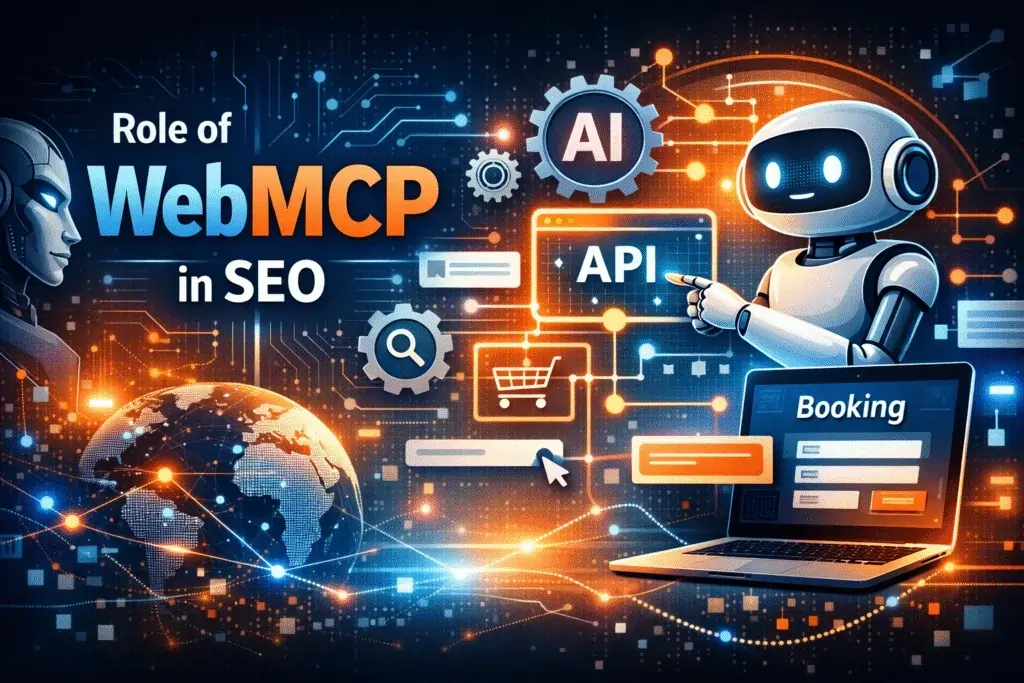
🔍 What Is WebMCP? A Quick Primer
At its core, WebMCP (Web Model Context Protocol) is an emerging web standard — co-developed by Google and Microsoft — designed to enable websites to communicate directly with AI agents via structured tool interfaces instead of making those agents scrape HTML or interpret screenshots.
Traditional AI agents that browse the web today often rely on brittle approaches like screenshot parsing or DOM scraping — methods prone to errors, sensitive to design changes, and highly inefficient. WebMCP transforms this by letting your site announce what it can do — such as “search products,” “submit forms,” or “complete bookings” — in a machine-readable way that agents can call directly.
Table of Contents
ToggleIn technical terms, WebMCP introduces a browser API (navigator.modelContext) that registers structured tools with clear input/output schemas, effectively turning your website into a set of callable APIs for AI agents.
This model has profound implications for SEO today and well into 2026.
🚀 WebMCP and the Evolution of SEO
Over the past decade, SEO has continuously evolved:
1990s – Simple keyword matching
2000s – Semantic search & structured data
2010s – Mobile-first indexing
2020s – AI-assisted search
2026 – The Agentic Web with WebMCP
What was once primarily about optimizing for bots that index text has shifted to optimizing for autonomous AI agents that interpret and execute actions on behalf of users. This is where WebMCP enters the picture — bridging human-oriented web design and agentic interaction layers.
🌐 From Crawling to Calling
Traditional SEO focuses on ensuring Googlebot can crawl and index pages correctly. But with WebMCP:
Agents don’t crawl your site like a human anymore — they call specific actions your site exposes.
Instead of scraping and guessing button functions, agents rely on structured capabilities you’ve declared.
This reduces computational overhead and dramatically improves reliability and accuracy for AI-driven workflows.
In essence, WebMCP is to AI agents what structured data (Schema.org) was to search engines: a way to explicitly define meaning and functionality in machine-readable form.
AEO aims to optimize content so that search engines and generative answers provide the best possible responses to user queries. The rise of assistant-driven results (like those from AI chat interfaces or agent-based systems) means your content needs to be understandable and actionable not just by humans, but by AI systems too.
WebMCP enhances AEO in a few important ways:
🔹 Better Understanding of Site Capabilities
AI agents need to know what your site can do — not just what it says. WebMCP lets you expose actionable components — such as search, bookings, form submissions — to these agents in a structured format.
For example, imagine an agent assisting a user to book travel:
Instead of merely returning a page link with flight deals, an agent could invoke a WebMCP function like searchFlights(origin, destination, date) directly — making your site’s functionality part of the answer.
This is a fundamental shift from simply answering “what is available” to actually performing tasks — a key goal of advanced AEO.
🔹 Reduced Ambiguity
AI systems struggle when they must infer UI patterns or guess user flows based on HTML and CSS. By using WebMCP:
You reduce ambiguity about what the site does and how actions work.
This improves the agent’s ability to generate accurate, actionable answers.
As generative engines (e.g., AI assistants like Gemini, Claude, or ChatGPT) become central to how users discover and interact with content, optimizing for these engines has become just as important as traditional SEO.
WebMCP plays a central role in GEO:
🔹 Optimizing for Agent Interaction
GEO is about ensuring generative systems understand your site’s structure, capabilities, and intents. With WebMCP, your site can:
Publish machine-readable action definitions.
Let agents discover what they can do with your content.
Provide agents with the exact parameters needed to execute tasks.
This effectively turns your website into an AI-friendly interface — something that generative engines prioritize when fetching, summarizing, or interacting with web content.
🔹 Competitive Advantage
SEO in 2026 isn’t just about appearing in search — it’s also about being usable to AI assistants. If your competitors haven’t adopted WebMCP, agents may ignore their sites because they cannot trust or interact with them reliably. Your site, however, becomes a preferred destination for agents, leading to:
Higher engagement
Better conversion rates
More AI-driven referrals
This is the core of GEO — optimizing for both consumption and action by generative engines.
🔧 How to Prepare Your Site for WebMCP
To stay ahead in 2026 and beyond, here are practical steps for SEO professionals:
✅ 1. Understand Your Core Actions
Map out the high-value interactions on your site — such as search, booking, checkout, and lead generation — and define them as structured tools.
✅ 2. Implement WebMCP APIs
Use the navigator.modelContext API to register your site’s tools. Ensure each tool has clear input/output schemas that AI agents can consume.
✅ 3. Monitor Adoption and Standards
WebMCP is currently in early preview in Chrome 146 and later versions and is being incubated as a W3C standard — meaning adoption will expand over 2026 and beyond.
✅ 4. Blend AEO and GEO Strategies
Your SEO strategy should combine:
Optimizing content for AI comprehension (AEO)
Optimizing interactions for agent consumption and execution (GEO)
This ensures your site is discoverable, understandable, and actionable by both humans and AI systems.
Conclusion: Why WebMCP Is a Game-Changer in SEO 2026
In the evolving web ecosystem of 2026, WebMCP represents a pivotal shift from traditional crawling and indexing towards a future where AI agents understand and interact with websites as structured interfaces.
For SEO professionals, this presents both a challenge and a massive opportunity. WebMCP:
Makes websites AI-agent friendly
Enhances discoverability beyond conventional search signals
Bridges AEO and GEO optimization strategies
Opens the door to richer user experiences and higher conversions
The websites that adopt WebMCP early will not only rank better in AI-driven discovery systems — they’ll be actively used by agents to perform tasks on behalf of users. In the age of AI assistants, that’s the ultimate frontier of SEO.

Abhay Saxena is an experienced SEO strategist, digital marketing consultant, and founder of SEO Pathshala, based in Delhi, India. With over 7 years of hands-on experience in Search Engine Optimization, he has helped businesses enhance their online visibility, improve organic rankings, and achieve measurable growth through structured and data-driven SEO frameworks.
His core expertise includes Technical SEO, Local SEO, Core Web Vitals optimization, Google Search Console strategy, GA4 analytics insights, and AI-powered search optimization including AEO (Answer Engine Optimization) and WebMCP integration.
Abhay is passionate about simplifying complex SEO concepts and regularly shares practical tutorials, industry insights, and real-world strategies through SEO Pathshala. His mission is to empower marketers, entrepreneurs, and business owners with sustainable SEO strategies that align with the evolving AI-first search ecosystem.