
How AI Overviews Are Changing SEO: What I'm Seeing in Client Data
Google AI Overviews cut organic clicks sharply: Ahrefs found position-one click-through rate fell 58% on affected keywords between December 2023 and December 2025. This post shows what that looks like in client Search Console data, how I check for it, and which fixes still protect traffic.
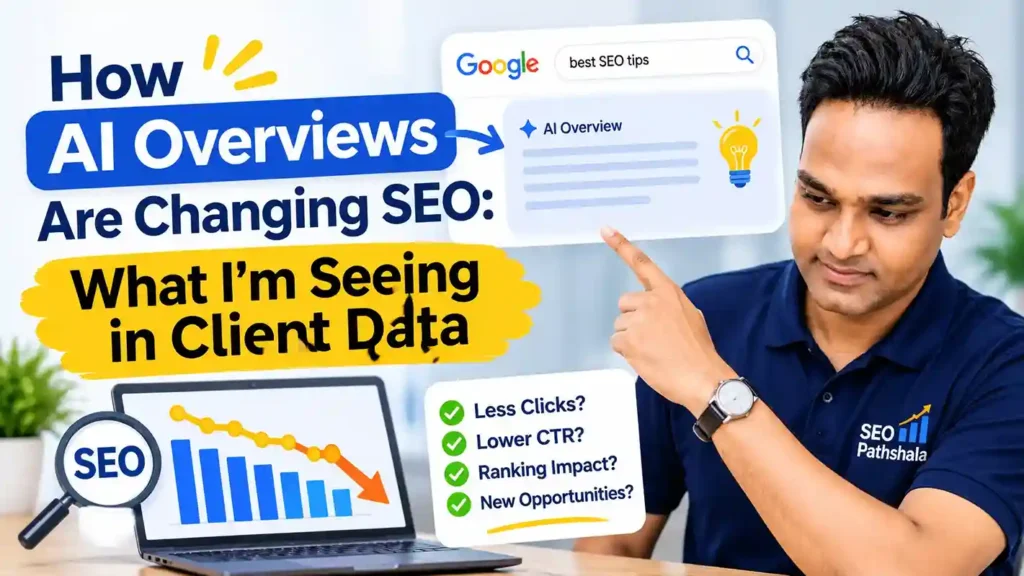
I’m Abhay Saxena, an SEO expert in Delhi NCR, and since AI Overviews rolled out I’ve changed how I report on every client account. Rankings alone no longer tell you whether an SEO campaign is working. Here is what the published data says, what to look for in your own numbers, and what I do about it.
Table of Contents
ToggleWhat Are Google AI Overviews, and Are They Live in India?
AI Overviews are AI-generated summaries that Google places above the regular results, with links to the pages it drew from. Google announced the rollout in India on 15 August 2024, in English and Hindi, so Delhi NCR searchers have been seeing them for over two years.
Google says links inside AI Overviews send higher-quality clicks. Independent studies, covered below, show fewer clicks overall. Both can be true at once: fewer visits, but possibly more engaged ones.
How Often Do AI Overviews Appear in Google Search?
Estimates vary widely because every vendor measures a different query set, and Google publishes no official figure. Treat these as ranges, not facts.
| Source | Finding | Method note |
|---|---|---|
| Pew Research Center | 18% of 68,879 Google searches showed an AI summary | US panel of 900 adults, March 2025 |
| Similarweb (reported July 2026) | About 43% of Google queries | No methodology published |
| Semrush (reported July 2026) | About 48% of Google queries | No methodology published |
The direction is clear even if the exact share isn’t: AI Overviews appear on far more searches than they did a year ago, and informational queries trigger them most.
Do AI Overviews Reduce Organic Clicks? What the Studies Show
Yes, on affected queries, and all three major studies agree on direction, though not on size. They measure different things, so don’t treat the numbers as interchangeable.
| Study | What was measured | Key result |
|---|---|---|
| Pew Research (July 2025) | Share of visits where a user clicked a regular result | 8% with an AI summary vs 15% without; 26% ended the session vs 16% |
| Ahrefs (February 2026) | Position-one CTR, 150,000 AI Overview keywords vs 150,000 without, Dec 2023 vs Dec 2025 | 58% lower CTR at position one; 19% lower at position ten |
| Seer Interactive (September 2025 update) | Organic CTR on 3,119 informational queries across 42 client organizations | 1.76% to 0.61% on AI Overview queries; 2.74% to 1.62% without |
Pew also found that only 1% of visits to pages with an AI summary included a click on a link inside the summary itself.
Which Positions Lose the Most Clicks?
Higher positions lose more, because they had more to lose. Ahrefs’ breakdown of CTR change when an AI Overview is present:
- Position 1: down 58.0%
- Position 2: down 50.8%
- Position 3: down 46.4%
- Positions 4 to 6: down roughly 31% to 39%
- Positions 7 to 9: down roughly 29%
- Position 10: down 19.4%
The practical lesson: ranking first is still worth having, but it is no longer enough on its own.
Does Being Cited in an AI Overview Help?
It is associated with more clicks, though Seer cautions that this may be correlation. In Seer’s Q3 2025 comparison, brands cited in an AI Overview earned 0.70% organic CTR against 0.52% for brands that weren’t cited, a 35% difference. Stronger brands are more likely to be cited in the first place, so citation may be a symptom of authority rather than the cause of clicks.
Either way, being cited beats being absent, which is why I now treat citation as a goal alongside ranking. My full breakdown is in the complete beginner’s guide to GEO.
What I'm Seeing in Client Data
The pattern I look for first is not a ranking drop. It is stable positions with falling clicks. When that appears on informational pages, an AI Overview is the usual suspect. Here is the layout I use to record it for each client, from Google Search Console and GA4.
| Client / page type | Period compared | Impressions | Clicks | Average CTR | Average position |
|---|---|---|---|---|---|
| [ADD: client or niche, e.g. local service site] | [ADD: e.g. Jan–Jun 2025 vs Jul–Dec 2025] | [ADD %] | [ADD %] | [ADD %] | [ADD] |
| [ADD: Boss Auto Rentals or other named client] | [ADD] | [ADD %] | [ADD %] | [ADD %] | [ADD] |
| [ADD: informational blog pages] | [ADD] | [ADD %] | [ADD %] | [ADD %] | [ADD] |
[ADD: 2 to 3 sentences on your real finding, for example which page types lost clicks, which held steady, and whether branded or local queries behaved differently.]
How Do You Check for AI Overview Impact in Google Search Console?
- Open Search Console, go to Performance, then Search results.
- Set the date filter to Compare, using the same number of days for both periods.
- Add a Query filter, choose Custom (regex), and enter
^(what|how|why|can|does|is|are|should)\bto isolate question-style searches. - Switch on Impressions, Clicks, CTR and Position in the summary bar.
- Look for impressions flat or rising, position stable, but clicks and CTR falling.
- Repeat on the Pages tab to find which URLs are affected, then check those queries manually in Google.
Search Console does not label AI Overview traffic separately, so this is an inference, not proof. Confirm by searching the query yourself.
Which Pages and Queries Are Hit First?
- Definition and “what is” pages: the answer fits in a summary, so there is little reason to click.
- How-to and list-style content: steps and tips get condensed directly into the overview.
- Comparison and “best of” posts: partly affected, with citations sometimes going to the page that structured its comparison clearly.
- Seer’s and Ahrefs’ data covers informational queries only, so don’t assume the same drop applies to transactional or local-intent searches without checking your own data.
How Do You Get Cited in AI Overviews?
There is no guaranteed method, and Google has not published a citation checklist. These are the steps I apply to client content because they match how answer engines extract information.
- Put a direct 30 to 60 word answer immediately under the heading or H1.
- Write headings as the questions people actually search.
- Use tables for comparisons and numbered or bulleted lists for steps.
- Cite named sources with dates for every statistic.
- Show real authorship and first-hand experience, which supports E-E-A-T.
- Keep business name, address and phone details identical everywhere online.
For the format side of this, see my guide to Answer Engine Optimization, and for the wider picture, the top 5 SEO trends in 2026 across AI, GEO and AEO.
What Mistakes Do People Make Reading AI Overview Data?
- Blaming AI Overviews for every drop. Seasonality, a core update, lost links or a technical fault can all cut clicks. Rule those out first.
- Comparing mismatched periods. Compare equal-length windows, and the same season where you can.
- Mixing metrics across studies. Pew measures share of users who clicked, Ahrefs measures position-one CTR, and Seer measures average CTR. A 58% drop and a 65% drop are not the same claim.
- Treating one client’s pattern as universal. A local clinic and an informational blog will behave very differently.
- Assuming the trend only runs one way. Some trackers report CTR partly recovering in early 2026, so check the latest months before drawing conclusions.
What Still Works in SEO Despite AI Overviews?
The fundamentals have not been replaced. AI Overviews draw on pages that already rank, so the work that earned rankings still earns eligibility for citation.
| Practice | Why It Still Matters |
|---|---|
| Crawlable, fast, well-structured pages | Pages Google can’t process can’t be cited or ranked |
| Original experience and data | A generic summary can’t reproduce what only you have seen |
| Clear authorship and credentials | Supports the trust signals that answer engines weigh |
| Local profile and reviews | Local searches depend heavily on Google’s own business data |
| Brand recognition | People who already know you click even when an overview appears |
In short, SEO has gained a second job. You still need the ranking, and now you also need to be the source the summary names.
How Should You Measure SEO When Clicks Fall?
| Metric | Where to Find It | What It Tells You |
|---|---|---|
| Impressions | Search Console | Whether you are still being shown, including inside AI answers |
| Clicks and CTR by page | Search Console | Which URLs are losing traffic |
| Conversions and leads | GA4 | Whether fewer visits still produce the same business result |
| Branded search volume | Search Console | Whether people remember you after seeing you cited |
| Manual AI citation checks | Google, ChatGPT, Gemini | Whether you are named in answers for your target queries |
Traffic is a means, not the goal. If visits drop but enquiries hold steady, the campaign is working. If both fall, the page needs rework.
What Should Delhi NCR Businesses Do Now?
- Audit informational pages first, since they take the biggest hit.
- Strengthen your Google Business Profile, as local intent leans on it, not only on blog traffic.
- Add specific, experience-based detail that a generic summary can’t replace.
- Report on leads and calls, not sessions alone.
- Refresh statistics and key pages at least every 12 to 18 months.
Frequently Asked Questions About AI Overviews and SEO
Do AI Overviews kill organic traffic?
They reduce clicks on queries where they appear, and Ahrefs measured a 58% lower CTR at position one. They do not remove organic traffic altogether, and the effect varies by query type.
Can you opt out of AI Overviews?
There is no setting to opt a site out of AI Overviews alone. Limiting snippets with directives like nosnippet restricts how your content appears in all of Google Search, so weigh that trade-off carefully before using it.
Does SEO still matter with AI Overviews?
Yes. AI Overviews pull from pages that Google already ranks and trusts, so strong technical SEO, helpful content and authority remain the foundation. The change is that visibility inside the answer now matters alongside the click.
How do I know if my site appears in AI Overviews?
Search your target queries manually in Google and note whether your site is linked in the overview. Search Console does not report AI Overview appearances separately, so manual checks or a third-party tracking tool are the only options.
Are AI Overviews available in Hindi?
Yes. Google launched AI Overviews in India in English and Hindi on 15 August 2024, with a button to switch between the two languages.
Should I stop writing informational blog posts because of AI Overviews?
No, but change the brief. Pages that only restate a definition are the most exposed, so add first-hand experience, original data, comparison tables and a clear next step. A post that earns a citation, builds brand recall and leads readers to a service page still pays its way, even when raw clicks are lower than before.
How often should I review AI Overview impact on my site?
Monthly is enough for most small business sites. Compare Search Console clicks, CTR and conversions against the previous period, and run a manual check on your top ten target queries each quarter, since the share of searches showing AI Overviews keeps changing.
Final Thoughts: Measure What Pays, Not Just What Ranks
AI Overviews have changed what a good SEO report looks like. Positions can hold while clicks fall, so the job now is to earn citations, protect conversions and report on outcomes. If you want a data-first review of your own Search Console numbers, see my SEO services in Delhi NCR.

Abhay Saxena is an experienced SEO strategist, digital marketing consultant, and founder of SEO Pathshala, based in Delhi, India. With over 7 years of hands-on experience in Search Engine Optimization, he has helped businesses enhance their online visibility, improve organic rankings, and achieve measurable growth through structured and data-driven SEO frameworks.
His core expertise includes Technical SEO, Local SEO, Core Web Vitals optimization, Google Search Console strategy, GA4 analytics insights, and AI-powered search optimization including AEO (Answer Engine Optimization) and WebMCP integration.
Abhay is passionate about simplifying complex SEO concepts and regularly shares practical tutorials, industry insights, and real-world strategies through SEO Pathshala. His mission is to empower marketers, entrepreneurs, and business owners with sustainable SEO strategies that align with the evolving AI-first search ecosystem.