
Boss Auto Rentals Case Study: Local SEO for an International Car Rental Client

When a New Zealand-based car rental company reaches out to an SEO consultant based in Delhi, the first question is usually: “Can you actually help a business that’s 10,000 kilometres away?” The short answer is yes — because local SEO is about optimising for geography, not operating from within it. This case study walks through exactly what I did for Boss Auto Rentals across their two New Zealand locations, why I made the specific decisions I did, and what the Google Business Profile data shows after three months of structured work.
Table of Contents
ToggleIf you’re a business owner or marketing manager trying to understand whether local SEO is worth the investment — or if you’re an SEO professional looking at how a multi-location local SEO engagement actually runs — this is a real account, with real numbers, not a curated highlight reel.
About the Client
Boss Auto Rentals operates a car rental business across New Zealand through bossrentals.kiwi, with two active Google Business Profile locations:
- Christchurch — the primary, more established location
- Rolleston — a second location in the Selwyn district, with a shorter GBP history
The business rents vehicles to locals and tourists, competing in a market that includes both large national chains and independent operators. The challenge for any independent car rental business is visibility — especially on Google Maps, where car hire intent searches are highly local and conversion-ready.
I began working with Boss Auto Rentals in May 2026.
The Starting Point: What the GBPs Looked Like
Before I started, both profiles had the basics in place — they were verified and had category assignments. But “existing” and “optimised” are different things. The key gaps I identified during the initial audit:
- Business descriptions that weren’t using natural keyword language around car hire intent terms specific to Canterbury
- Thin photo libraries with no regular refresh cadence — Google weights both recency and richness of visual content in local ranking
- Incomplete service attributes — specific vehicle types, fuel policy, and booking options weren’t clearly listed
- Empty Q&A sections on both profiles — a missed opportunity to pre-answer high-intent buyer questions while adding keyword-relevant content to the profile
- No GBP post cadence — zero posts being published, which signals an inactive profile
- Inconsistent review responses — reviews existed but there was no strategy for generating them steadily or responding in a way that reinforces local relevance
For a detailed walkthrough of the GBP optimisation levers I work through on every local engagement, the Top 5 Google Business Profile Optimization Tips for 2026 post covers the exact framework I apply to every profile before touching anything else.
The Strategy: What I Actually Did
1. GBP Deep Optimisation (Both Locations)
Month one was spent getting both profiles to a point where they were sending the right signals to Google’s local algorithm. This meant:
- Rewriting business descriptions with natural, intent-aligned language — “affordable car rental in Christchurch” and “car hire Rolleston” — without keyword stuffing, but without leaving ranking opportunities on the table
- Completing every applicable attribute section: payment methods, booking options, accessible facilities, fleet categories
- Uploading location-specific photos for each branch — exterior shots, vehicle fleet images, and lot photos tagged with correct location metadata
- Building out the Q&A section with 8–10 seeded questions and answers covering the most common pre-booking queries: deposit policy, age requirements, airport pickup availability, and one-way hire options
2. Consistent GBP Post Publishing
Starting May 2026, I implemented a regular posting cadence for both profiles — typically 2–3 posts per week per location. Content rotated between:
- Offer posts around seasonal promotions and weekend rates
- Update posts highlighting fleet additions or service changes
- Event posts tied to local Canterbury events that drive rental demand — long weekends, regional festivals, domestic tourism peaks
This matters because GBP posts signal an active, well-managed business and feed fresh content into the profile — both of which influence the prominence component of Google’s local ranking algorithm.
3. Review Velocity Strategy
One of the clearest ranking levers in local SEO is consistent review velocity. I built a simple, repeatable review request process for the Boss Auto Rentals team — triggered at the point of vehicle return, using a direct GBP review link that reduces friction to a single tap. Response templates were also drafted so every review, positive or negative, gets a timely, natural-sounding reply that includes location-relevant language without sounding robotic.
4. Multi-Location Differentiation
With two locations ranking in the same general Canterbury region, there is a real risk of profile cannibalisation — where both GBPs compete for the same local queries and dilute each other’s prominence signals. To prevent this:
- Each profile was given distinct primary and secondary category assignments
- Service descriptions emphasised geographic specificity — Rolleston content positioned the branch as the accessible option for the Selwyn district, clearly separate from central Christchurch
- All photo content was unique per location — no shared assets across profiles
This approach mirrors what I apply when managing multi-location clients under Local SEO services in Delhi NCR — the cannibalisation risk and the differentiation solution are the same regardless of geography.
5. Website-Side Local Signals
GBP optimisation does not operate in isolation. For bossrentals.kiwi, I reviewed and flagged recommendations on:
- Location-specific landing pages for Christchurch and Rolleston with unique, locally relevant content
- NAP (Name, Address, Phone) consistency between the website footer, contact page, and each GBP listing
- Embedded Google Maps on location pages
- LocalBusiness schema on relevant pages, with
geocoordinates andhasMapproperties correctly populated
The Results: GBP Performance Data (May–Aug 2026)
All figures below come directly from the Google Business Profile performance panel for each location.
Christchurch Location — May 2026 to Aug 2026
| Metric | 4-Month Total | Peak Month | Trend |
|---|---|---|---|
| Business Profile Interactions | 550 | July (187) | ~50 in May → 187 in July |
| Calls from GBP | 19 | August (trending ~9) | Dip in June, rising from July |
| Chat Clicks | 3 | July (2) | Low volume, growing |
| Direction Requests | 157 | June (~58) | Strong peak, moderated in Aug |
| Website Clicks | 371 | July (131) | Strongest metric; near-linear growth |
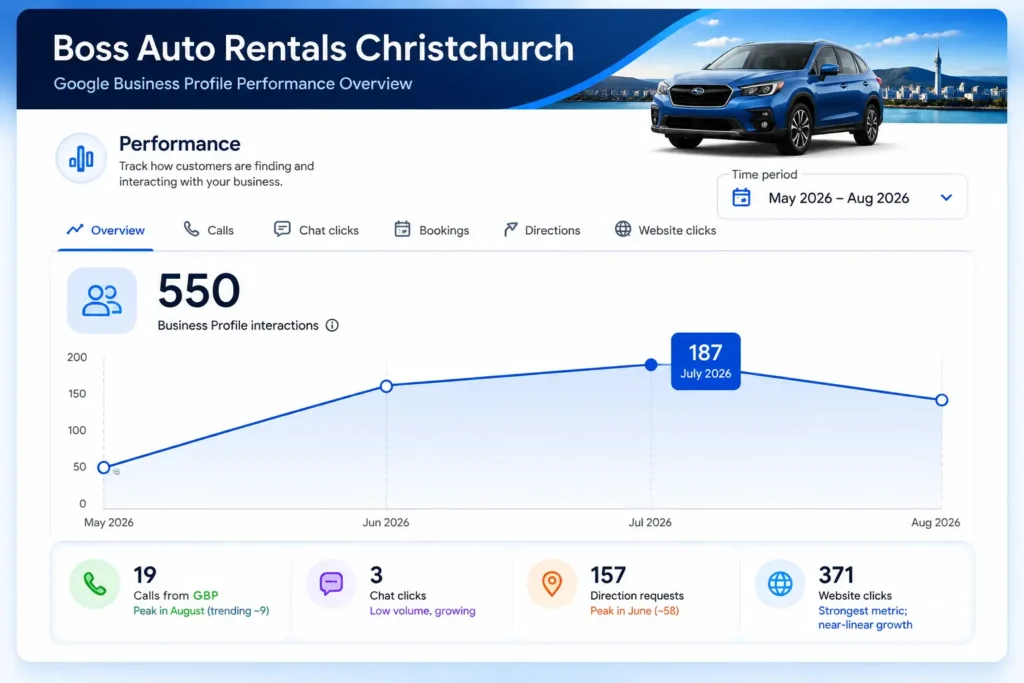
The headline number: Christchurch went from roughly 50 total interactions in May to 187 in July — a 3.7× increase over three months. Website clicks are the standout metric, peaking at 131 in July, confirming the profile is functioning as a discovery and trust signal that sends users to the booking page.
Direction requests peaked in June and softened after — this is a normal pattern for a maturing profile where new users who needed navigation confirmation in the early months are becoming repeat customers who navigate directly. The August moderation across metrics is consistent with New Zealand’s late-winter seasonal pattern, not a performance concern.
Rolleston Location — Mar 2026 to Aug 2026
The Rolleston panel shows data from March 2026 because the profile pre-existed my engagement. Structured work began in May 2026; the growth from that point reflects the engagement.
| Metric | Full- Window Total | Peak Month | Trend |
|---|---|---|---|
| Business Profile Interactions | 505 | July (~135) | ~10 in Mar → 135 in July |
| Calls from GBP | 15 | July (7) | Flat to May, sharp rise from July |
| Chat Clicks | 4 | August (2) | Trending up |
| Direction Requests | 242 | June (~73) | Strong peak, moderating |
| Website Clicks | 244 | July (90) | Near-zero in March → 90 in July |
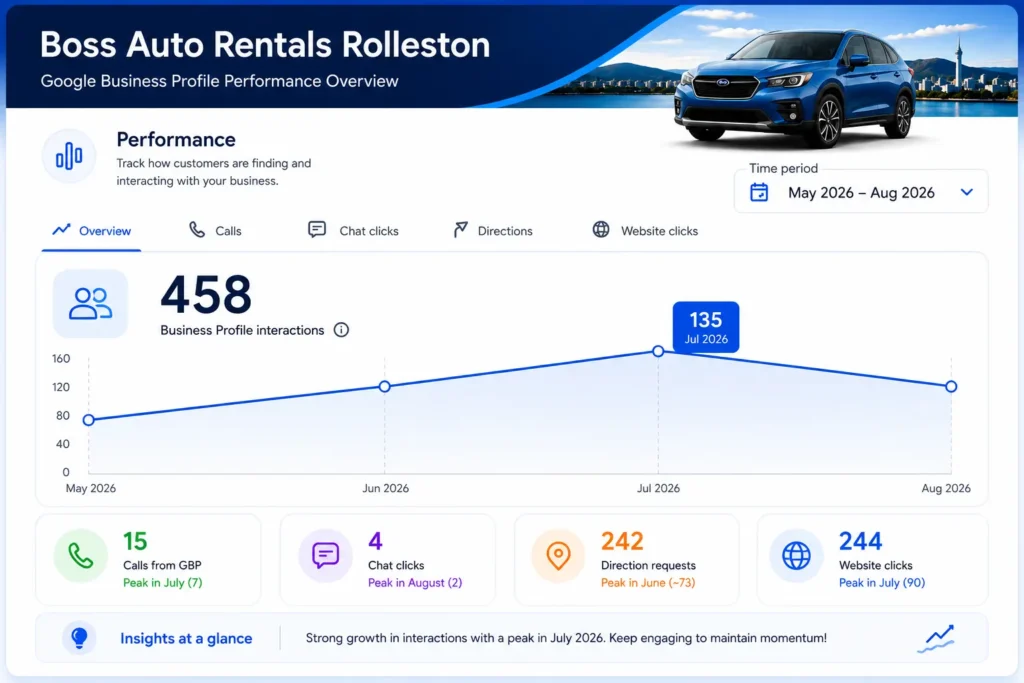
Rolleston’s trajectory is particularly strong on a percentage basis because it started from a much lower base. Website clicks went from near-zero in March to 90 in July — and that growth is concentrated in the post-May period. Direction requests at 73 in June are notable for a secondary branch in a less densely populated area. Calls — the most direct conversion signal for a car rental business — jumped to 7 in July after being near-flat through May and June.
What the Data Actually Shows
A few observations for anyone reading this as a client or fellow practitioner:
GBP results have an 8–12 week lag. May was setup and optimisation. The data starts showing meaningful movement in June and accelerates in July — which is a realistic and honest timeline for this type of engagement. Anyone promising local SEO results in 2–3 weeks is not being straight with you.
Website clicks are the most meaningful GBP metric for a rental business. For Boss Auto Rentals, customers need to check pricing and availability before committing. The GBP is the discovery point; the website is where conversion happens. Website clicks consistently outperforming direction requests and calls confirms the profile is working correctly as a top-of-funnel asset.
Multi-location profiles need to be read independently. Christchurch had higher baseline activity; Rolleston showed steeper percentage growth from a lower base. Applying the same optimisation pressure to both without accounting for their different competitive environments and starting points would produce worse results for both.
The August dip is seasonal, not structural. Both profiles show slight softening in August. New Zealand’s August is late winter — the Canterbury tourism season hasn’t yet picked up. The September–November spring period typically drives significant domestic and international rental demand in this region, and the profiles are well-positioned to capture it.
What Comes Next
The next phase for both locations focuses on:
- Sustained review velocity through September and into the spring season — review recency and volume are among the most heavily weighted prominence signals in Google’s local algorithm
- Seasonal GBP content — ramping up posts ahead of New Zealand’s peak rental season (September–January) to capture increased search demand
- Local citation expansion — building NAP citations across New Zealand-specific directories, tourism platforms, and Canterbury regional listings
- Conversion optimisation on the booking flow — ensuring that the website click volume the GBP is now generating translates efficiently into completed reservations
On Working with an International Client
The most common reaction when I mention this engagement is surprise — why would a New Zealand business work with a Delhi-based SEO consultant? The practical answer is that local SEO strategy is transferable. Google’s ranking algorithm for local search uses the same signals everywhere: relevance, distance, and prominence. What changes is the local market knowledge required to execute correctly.
For Boss Auto Rentals, that meant researching Canterbury-specific search behaviour, understanding seasonal demand patterns in the New Zealand tourism calendar, and ensuring that keyword choices reflect how people in Christchurch and Rolleston actually search — not how car rental is searched generically. The remote element changes the research process; it does not change the fundamentals.
Work With Me on Your Local SEO
Boss Auto Rentals is one of several local businesses I manage as part of my practice at SEO Pathshala. If your Google Business Profile is not generating the calls, website clicks, or direction requests it should be — or if you are running multiple locations and need a differentiated strategy for each — I can audit what’s holding the profiles back and build a plan to fix it.
Explore Local SEO services in Delhi NCR →
Get in touch to discuss your situation. The first conversation is always free.

Abhay Saxena is an experienced SEO strategist, digital marketing consultant, and founder of SEO Pathshala, based in Delhi, India. With over 7 years of hands-on experience in Search Engine Optimization, he has helped businesses enhance their online visibility, improve organic rankings, and achieve measurable growth through structured and data-driven SEO frameworks.
His core expertise includes Technical SEO, Local SEO, Core Web Vitals optimization, Google Search Console strategy, GA4 analytics insights, and AI-powered search optimization including AEO (Answer Engine Optimization) and WebMCP integration.
Abhay is passionate about simplifying complex SEO concepts and regularly shares practical tutorials, industry insights, and real-world strategies through SEO Pathshala. His mission is to empower marketers, entrepreneurs, and business owners with sustainable SEO strategies that align with the evolving AI-first search ecosystem.