
Top 10 Local SEO Ranking Factors in 2026
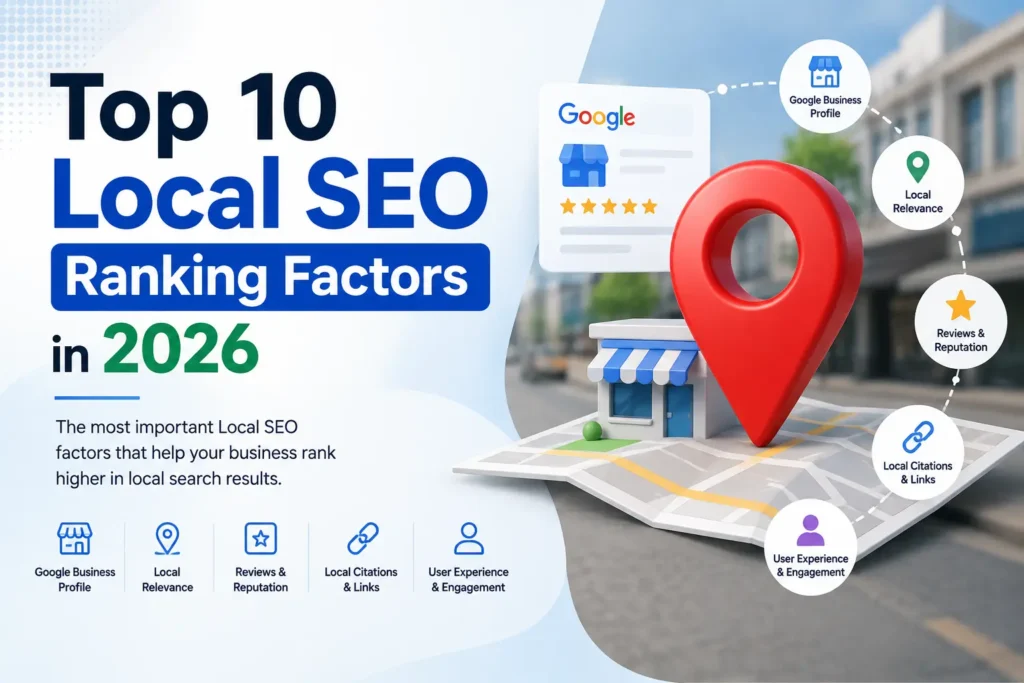
The top local SEO ranking factors in 2026 are Google Business Profile completeness, proximity to the searcher, NAP consistency, review quantity and quality, localized on-page content, local citations and links, technical site health, behavioral signals like calls and direction requests, LocalBusiness structured data, and visibility inside AI-driven local answers.
Table of Contents
ToggleIf you run a business with a physical location or a defined service area, ranking factors like these decide whether you show up in the Google Map Pack — or get buried behind three competitors who took local SEO seriously. This guide breaks down exactly what moves the needle in 2026, in order of impact, so you know where to focus first.
Why Local SEO Ranking Factors Matter More in 2026
oogle’s local algorithm has always weighed relevance, distance, and prominence — but how it calculates “prominence” has shifted. Reviews, engagement signals, and AI-summarized business information now carry more weight than raw citation volume did a few years ago. At the same time, AI Overviews and Google’s AI-powered local answers are starting to pull directly from Business Profile data and on-site structured data when someone asks “best [service] near me” — which means local SEO now overlaps with AEO and GEO in a way it didn’t before.
If you’d rather have these factors implemented and monitored than DIY them, expert Local SEO services in Delhi NCR can handle the full audit-to-execution cycle — but even if you’re managing this in-house, the ten factors below are where to spend your time.
The 10 Local SEO Ranking Factors That Matter Most in 2026
1. Google Business Profile Completeness & Optimization
This is still the single highest-leverage local ranking factor. A fully completed profile — accurate category selection, business description, services list, attributes, hours, and regularly updated photos — consistently outperforms partially filled listings. Google’s own local algorithm treats profile completeness as a trust and relevance signal, and incomplete profiles are far less likely to surface for discovery searches (people who don’t yet know your business name).
If you haven’t optimized your listing recently, start with our Google Business Profile optimization tips before touching anything else on this list.
2. Proximity to the Searcher
Distance between the searcher’s location and your business address remains one of the three core local ranking pillars (alongside relevance and prominence). You can’t change your physical address to chase rankings, but you can make sure your service-area settings, address formatting, and location pages accurately reflect every area you genuinely serve — which affects how far your visibility extends.
3. NAP Consistency Across the Web
Your business Name, Address, and Phone number (NAP) need to match exactly — down to abbreviations and formatting — across your website, Google Business Profile, and every directory or citation source. Inconsistent NAP data is one of the most common reasons an otherwise well-optimized business fails to rank, because it undermines the trust signal Google uses to confirm your business is legitimate and correctly located.
4. Online Reviews — Quantity, Recency & Response Rate
Review volume, average rating, review recency, and how consistently you respond to reviews all factor into local rankings. What’s changed in 2026 is that recency and response rate now matter almost as much as star rating — a business with a steady stream of recent reviews and thoughtful owner responses tends to outrank one with more total reviews that have gone stale. Review content also feeds Google’s AI-generated review summaries, so the language customers use in reviews increasingly shapes how your business gets described in search.
5. Localized On-Page Content
Your website needs to reinforce what your Business Profile claims. This means location-specific landing pages (not one generic “services” page trying to rank everywhere), city or neighborhood names used naturally in titles and headers, and content that speaks to local context — not templated text copied across every location page. Thin or duplicated location pages are a common reason multi-location businesses underperform locally despite strong individual reviews.
6. Local Citations & Link Building
Citations (mentions of your business on directories, local news sites, and industry-specific listings) and backlinks from locally relevant, authoritative sites still contribute to prominence. The bar has risen, though — a handful of citations from genuinely relevant local sources now outperforms dozens of low-quality directory submissions, which Google’s algorithm has gotten better at discounting.
7. Technical Site Health & Core Web Vitals
A slow, poorly structured website undermines every other local SEO effort. Core Web Vitals (loading speed, interactivity, visual stability), mobile-friendliness, and clean crawlability all affect whether your location pages rank — and whether visitors who do click through actually convert into calls or visits.
8. Behavioral Signals (Clicks, Calls & Direction Requests)
Google tracks how searchers interact with your Business Profile and website — click-through rate, calls initiated directly from the listing, and requests for directions. High engagement relative to impressions signals to Google that your business genuinely satisfies the searcher’s intent, which reinforces your position for similar future searches.
9. Local Business Structured Data
Adding accurate LocalBusiness schema markup to your website — address, phone, hours, geo-coordinates, and service area — gives search engines and AI systems an unambiguous, machine-readable version of your business details. This matters more in 2026 because AI-driven local answers lean on structured data to confirm accuracy before citing a business, especially when the same information also appears consistently in your Business Profile.
10. Visibility in AI-Driven Local Answers (GEO for Local Search)
The newest ranking factor: whether your business gets surfaced when someone asks an AI assistant or Google’s AI Overview a local, conversational question like “which [service] near me has the best reviews.” This depends on the nine factors above being in sync — consistent NAP, strong recent reviews, structured data, and content that clearly answers “who, what, where” without ambiguity. Businesses that treat local SEO and GEO as separate efforts are already falling behind those treating them as one system.
How to Prioritize These Local SEO Ranking Factors
If you’re starting from scratch, work in this order: complete and verify your Google Business Profile, fix any NAP inconsistencies, then build a review generation process, and only after that invest in citations and content. Trying to build links before your fundamentals (profile, NAP, reviews) are solid is the most common reason local SEO campaigns underperform.
Frequently Asked Questions
What are the top local SEO ranking factors in 2026?
Google Business Profile completeness, proximity, NAP consistency, reviews, localized content, citations and links, technical site health, behavioral signals, structured data, and visibility in AI-driven local answers.
How much does Google Business Profile affect local rankings?
It’s widely considered the single most influential factor — a complete, accurate, and actively managed profile consistently outperforms one that’s left partially filled or unmonitored.
Do backlinks matter for local SEO?
Yes, but quality over quantity matters more than ever. A few links from genuinely relevant, locally authoritative sites outperform a large volume of generic directory citations.
How important are reviews for local SEO in 2026?
Very important — not just star rating, but recency and how consistently the business responds. A steady stream of recent, responded-to reviews tends to outperform a large batch of old ones.
How can I check my local SEO ranking factors?
Start with a Google Business Profile audit (completeness, categories, photos), a NAP consistency check across directories, and a technical review of your site’s Core Web Vitals and structured data.

Abhay Saxena is an experienced SEO strategist, digital marketing consultant, and founder of SEO Pathshala, based in Delhi, India. With over 7 years of hands-on experience in Search Engine Optimization, he has helped businesses enhance their online visibility, improve organic rankings, and achieve measurable growth through structured and data-driven SEO frameworks.
His core expertise includes Technical SEO, Local SEO, Core Web Vitals optimization, Google Search Console strategy, GA4 analytics insights, and AI-powered search optimization including AEO (Answer Engine Optimization) and WebMCP integration.
Abhay is passionate about simplifying complex SEO concepts and regularly shares practical tutorials, industry insights, and real-world strategies through SEO Pathshala. His mission is to empower marketers, entrepreneurs, and business owners with sustainable SEO strategies that align with the evolving AI-first search ecosystem.