Top 10 SEO Skills to Learn in 2026 (Beginner to Advanced)
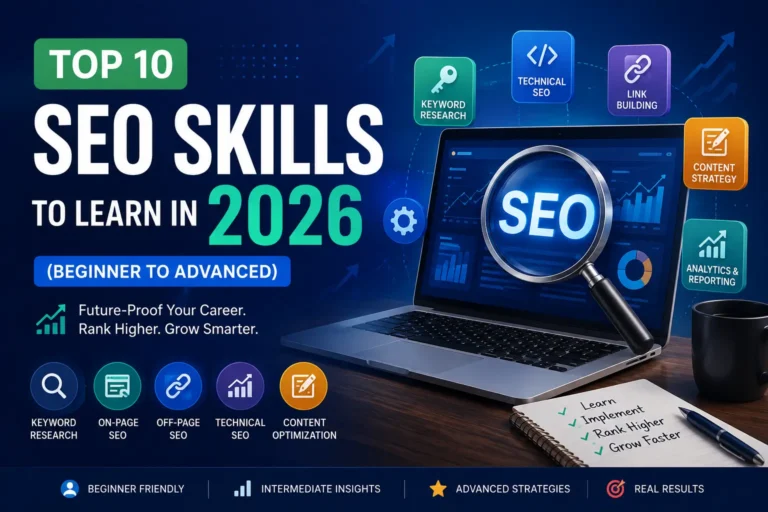
The top SEO skills to learn in 2026 are keyword research, on-page optimization, technical SEO, Core Web Vitals, local SEO, link building, analytics (GA4 & GSC), structured data, and two newer skills — Answer Engine Optimization (AEO) and Generative Engine Optimization (GEO) — which help content get cited inside AI Overviews, ChatGPT, and Google’s AI-driven search results.
Table of Contents
ToggleIf you’re planning to build a career in digital marketing, or you’re already working in SEO and want to stay relevant as AI reshapes search, this guide breaks down exactly which skills matter, in what order to learn them, and how each one connects to real ranking and visibility outcomes in 2026.
Why SEO Skills Look Different in 2026
Search itself has changed. Google’s AI Overviews now answer a large share of queries directly on the results page, and platforms like ChatGPT, Perplexity, and Gemini have become genuine discovery channels alongside Google. This doesn’t make traditional SEO obsolete — keyword research, technical health, and content quality still form the foundation. But it does mean two things: first, the fundamentals need to be executed better than ever, because AI systems reward clarity and structure; and second, a few new skills (AEO, GEO, structured data at a deeper level) have moved from “nice to have” to essential.
The list below is ordered beginner to advanced, so you can use it as a learning roadmap rather than just a reference list. And if you’d rather skip the trial-and-error and learn SEO from a working practitioner who applies these exact skills on live client projects in Delhi NCR, that’s the fastest way to build them properly.
The 10 SEO Skills Every Professional Needs in 2026
1. Keyword Research & Search Intent Mapping (Beginner)
Every SEO skill on this list depends on getting this one right first. Keyword research in 2026 isn’t just about search volume — it’s about mapping each keyword to the intent behind it (informational, navigational, commercial, or transactional) and understanding how that intent shows up differently across Google, AI Overviews, and chat-based assistants. Beginners should get comfortable with tools like Google Keyword Planner, Ubersuggest, and Google Search Console’s “Queries” report before moving to paid tools.
Pro tip: Look at the “People Also Ask” and “Related Searches” sections for your target keyword — they reveal the exact sub-questions AI Overviews are already answering, which is where your content needs to compete.
2. On-Page SEO & Content Optimization (Beginner)
This covers title tags, meta descriptions, header hierarchy, keyword placement, internal linking, and — increasingly — answering the core query within the first 100 words of the page. That last point matters more in 2026 than it did a few years ago, since a large share of AI Overview citations pull from the first 30% of a page’s content.
Sub-skills to build: writing scannable content, using semantic HTML (H1–H3 hierarchy), optimizing images with descriptive alt text, and structuring listicles/guides so both readers and AI crawlers can parse them quickly.
3. Technical SEO Fundamentals (Beginner–Intermediate)
Technical SEO is where most beginners get intimidated, but the core concepts are learnable: crawlability, indexability, XML sitemaps, robots.txt, canonical tags, and site architecture. If Google (or an AI crawler) can’t crawl and understand your site, none of your content or keyword work matters.
Start with: Google Search Console’s Coverage and Indexing reports, a basic understanding of how crawl budget works, and how to diagnose noindex or redirect issues — these are the most common reasons pages fail to rank even after good content is published.
4. Core Web Vitals & Page Experience (Intermediate)
Site speed and user experience metrics — Largest Contentful Paint (LCP), Interaction to Next Paint (INP), and Cumulative Layout Shift (CLS) — directly affect both rankings and conversion rates. This skill sits at the intersection of SEO and basic web development, so you’ll need to get comfortable reading a PageSpeed Insights or Lighthouse report and translating it into actionable fixes (image compression, lazy loading, reducing render-blocking scripts).
5. Local SEO & Google Business Profile Management (Intermediate)
For any business with a physical location or service area — clinics, institutes, retail, service providers — local SEO is often the highest-ROI skill on this list. It covers Google Business Profile optimization, local citations, review generation and response strategy, and local link building. In competitive markets like Delhi NCR, businesses that actively manage their GBP listing and collect consistent reviews routinely outrank competitors with stronger domains but weaker local signals.
6. Link Building & Digital PR (Intermediate)
Backlinks remain one of the strongest ranking factors, but the tactics have matured. Effective 2026 link building leans on digital PR (getting cited in genuine news and industry coverage), guest contributions on relevant sites, and building linkable assets like original data or tools — rather than the mass outreach and low-quality directory submissions that used to work.
7. SEO Analytics & Data Interpretation (Intermediate–Advanced)
Knowing how to execute SEO tactics isn’t enough — you need to prove and improve results. This means being fluent in Google Analytics 4, Google Search Console, and a reporting tool like Looker Studio, and knowing how to connect organic traffic changes to specific pages, queries, or algorithm updates. It’s also the skill that separates SEOs who can justify their work to clients or management from those who can’t.
8. Structured Data & Schema Markup (Advanced)
Schema markup (using JSON-LD) helps search engines and AI systems understand exactly what a page is about — an Article, a Product, a LocalBusiness, an Organization — rather than inferring it from text alone. This has become more important, not less, as AI Overviews and answer engines rely heavily on structured, unambiguous signals to decide what to cite. Learning to build a clean, minimally redundant @graph schema is now a genuinely advanced, high-value skill.
9. Answer Engine Optimization — AEO (Advanced)
AEO is the practice of structuring content so it can be lifted directly into a direct-answer format — Google’s featured snippets, AI Overviews, or voice assistant responses. This means writing concise, self-contained answers (typically 30–60 words) near the top of a page, using clear question-based subheadings, and organizing content so each section can stand alone as a complete answer.
10. Generative Engine Optimization — GEO (Advanced)
GEO is the newest and most advanced skill on this list: optimizing content so it gets referenced or cited by generative AI tools like ChatGPT, Gemini, and Perplexity — not just ranked by traditional Google search. It overlaps heavily with AEO and structured data, but adds its own layer: original data and statistics (with sources), clear author expertise signals (E-E-A-T), and content that’s easy for an LLM to extract and paraphrase accurately without losing meaning.
How to Learn These SEO Skills the Practical Way
Reading about SEO skills only gets you so far — the fastest way to actually build them is by working on live websites where you can see the ranking and traffic impact of each change. Structured training that pairs each skill with real client work (audits, on-page fixes, GBP optimization, schema implementation) compresses months of trial-and-error into weeks. If you’re preparing for interviews once you’ve built these skills, it’s also worth reviewing common SEO interview questions and answers so you can explain not just what you did, but why it worked.
Frequently Asked Questions
What SEO skills should a beginner learn first in 2026?
Start with keyword research and search intent mapping, followed by on-page SEO and basic technical SEO (crawlability, indexing, sitemaps). These three form the foundation every other skill on this list builds on.
Is SEO still a good career in 2026 with AI search growing?
Yes — AI search has changed how people find answers, but it hasn’t removed the need for websites to be technically sound, well-structured, and trustworthy. SEO professionals who add AEO and GEO skills to their toolkit are in strong demand, not less.
Do I need coding skills to learn SEO?
No, coding isn’t mandatory, but a basic understanding of HTML, and comfort reading (not necessarily writing) JSON-LD schema and simple CSS, makes technical SEO and structured data work significantly easier.
How long does it take to learn SEO from scratch?
Most beginners can grasp the fundamentals (keyword research, on-page, basic technical SEO) in 4–6 weeks of focused learning. Reaching an advanced level — technical audits, schema, AEO/GEO — typically takes 6–12 months of hands-on practice on real websites.
What is the highest-paying SEO skill in 2026?
Technical SEO and structured data/schema expertise tend to command the highest pay, since fewer professionals are genuinely skilled at them. AEO and GEO are quickly closing that gap as businesses compete for visibility inside AI-generated answers.

Abhay Saxena is an experienced SEO strategist, digital marketing consultant, and founder of SEO Pathshala, based in Delhi, India. With over 7 years of hands-on experience in Search Engine Optimization, he has helped businesses enhance their online visibility, improve organic rankings, and achieve measurable growth through structured and data-driven SEO frameworks.
His core expertise includes Technical SEO, Local SEO, Core Web Vitals optimization, Google Search Console strategy, GA4 analytics insights, and AI-powered search optimization including AEO (Answer Engine Optimization) and WebMCP integration.
Abhay is passionate about simplifying complex SEO concepts and regularly shares practical tutorials, industry insights, and real-world strategies through SEO Pathshala. His mission is to empower marketers, entrepreneurs, and business owners with sustainable SEO strategies that align with the evolving AI-first search ecosystem.