
Top 10 Local SEO Tips to Rank on Google Maps in 2026
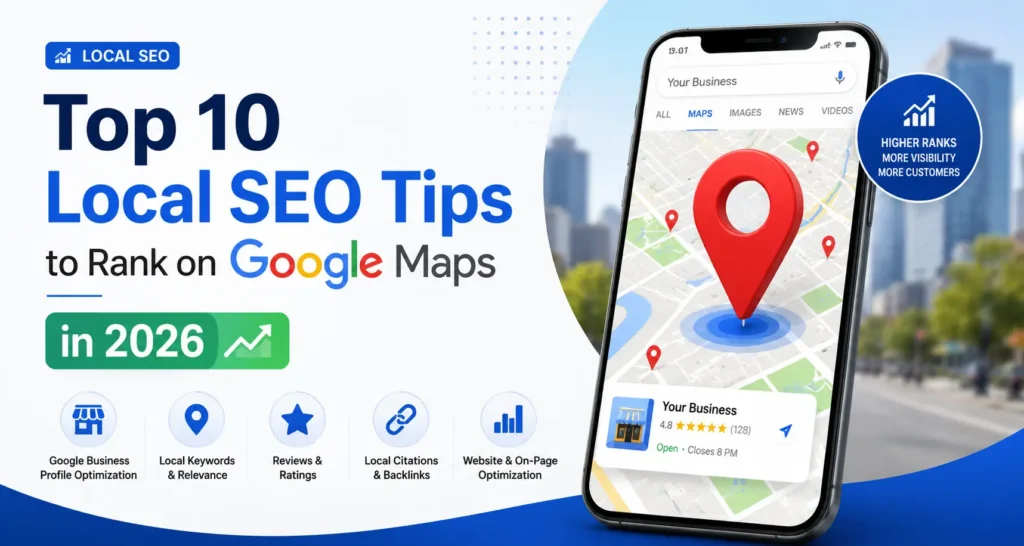
If your business is not showing up in Google Maps results, you are losing customers to competitors who may be doing worse work than you — just better local SEO. In 2026, ranking in the local map pack (the three business listings that appear above organic results) is one of the highest-ROI digital marketing moves a small business can make. The clicks are free, the intent is high, and the leads are local.
Table of Contents
ToggleThis guide gives you 10 proven local SEO tips, built from real campaign experience in Delhi NCR and backed by what Google actually measures today. Whether you run a clinic, a law office, a restaurant, or a service business, these tips apply directly to your situation.
What Is Local SEO and Why Does It Matter in 2026?
Local SEO is the process of optimising your online presence so Google shows your business to nearby customers when they search for what you offer. A search like “SEO services near me” or “dentist in Dwarka” triggers local results — a map, three business listings, and organic results below them.
The map pack sits above everything else. If you are not in it, most searchers will never reach you. With Google’s AI Overviews now pulling directly from Google Business Profile (GBP) data, local signals matter more than they ever have. Getting this right in 2026 means understanding both traditional local ranking signals and how AI search surfaces local businesses.
Top 10 Local SEO Tips to Rank on Google Maps in 2026
1. Claim and Fully Complete Your Google Business Profile
Your Google Business Profile is the single most important local SEO asset you control. If you have not claimed it yet, go to business.google.com and do it today before anything else.
Once claimed, fill every section completely: business name, category (primary and secondary), address, phone number, website, hours (including special hours for holidays), services, products, and business description. Google rewards completeness. An incomplete profile signals to the algorithm that you are not an active, trustworthy business.
Pro tip for Delhi NCR businesses: Write your business description in plain English (or Hindi where appropriate), mention your neighbourhood or locality, and include two or three natural keyword phrases your customers actually search for. Do not keyword-stuff — it reads badly and Google’s classifiers catch it.
2. Choose the Right Primary Business Category
Your primary category is one of the most powerful ranking signals in local SEO, and most businesses get it wrong by being too generic. “Restaurant” is not the same as “North Indian Restaurant” or “Dhaba.” “Doctor” is not the same as “Dermatologist.”
Spend fifteen minutes researching which category your top local competitors use. Open Google Maps, search for your main keyword, click on the top three results, and check their categories. Use the most specific accurate category available. Then add two or three secondary categories that reflect your other services.
Changing your primary category can shift your map pack position within days — it is that impactful.
3. Build NAP Consistency Across Every Platform
NAP stands for Name, Address, Phone Number. Google cross-references your business details across dozens of platforms — Justdial, Sulekha, IndiaMart, Yelp, Facebook, your website, and hundreds of citation sites — to verify that your business is legitimate and correctly located.
If your address appears as “12, Rohini Sector 7” on your website but “12 Rohini, Sector-7” on Justdial, Google treats these as potentially different businesses. Inconsistency confuses the algorithm and dilutes your local authority.
Audit your NAP across every platform where your business is listed and make every entry identical, character for character. This is boring work, but it is one of the most reliable ways to improve your map pack standing.
4. Get More Google Reviews (And Respond to All of Them)
Reviews are both a ranking factor and a conversion factor. Businesses with more recent, high-quality reviews outrank those without — even when other signals are similar. In 2026, Google’s local ranking algorithm weighs review velocity (how often you get new reviews), review sentiment, and your response rate.
The most effective way to get reviews is simply to ask, immediately after a positive customer interaction. Send a WhatsApp message or SMS with a direct link to your Google review page. Make it one tap, not a search.
Set aside ten minutes every week to respond to every review — five stars and one star. Responding to negative reviews professionally shows Google and potential customers that you take feedback seriously. Ignoring reviews, especially negative ones, is a signal that your business is not actively managed.
Delhi NCR tip: If your customers speak Hindi, respond in Hindi occasionally. Google indexes review responses and it demonstrates local relevance.
5. Post on Google Business Profile Weekly
Most business owners set up their GBP and never touch it again. That is a wasted opportunity. Google treats GBP posts as a freshness signal — active profiles that post regularly rank better than dormant ones.
Post at minimum once a week. Share offers, new services, before-and-after work examples, team updates, or tips related to your industry. Use the “Offer” post type when you have a promotion — Google surfaces these more prominently in the map pack.
Each post can include a photo, a call to action, and a link. Link to your most relevant service page. Keep posts between 100 and 200 words and include your primary keyword naturally. Think of GBP posts as free real estate in Google’s ecosystem — use it.
6. Add High-Quality Photos and Videos Regularly
Businesses with more photos get significantly more direction requests and website clicks than those without, according to Google’s own GBP data. Photos signal that your business is real, active, and worth visiting.
Upload photos in these categories at minimum: exterior (so customers can find you), interior, team, products or services in action, and a few customer interaction shots (with permission). Aim for at least 15–20 photos to start, then add two or three new ones every month.
Videos perform even better. A 30-second walkthrough of your office or a quick before-and-after clip from a service you completed can push your profile significantly ahead of competitors who only have stock images. Name your photo files descriptively before uploading — “seo-consultant-delhi-office.jpg” is better than “IMG_4821.jpg.”
7. Build Local Citations on High-Authority Directories
Beyond your GBP, Google uses citations — mentions of your business name, address, and phone number on third-party sites — to validate your local presence. The more quality citations you have (with consistent NAP), the more confident Google becomes that your business is where you say it is.
For Indian businesses, the priority citation sources are: Justdial, Sulekha, IndiaMart, TradeIndia, Yellow Pages India, Bing Places, Apple Maps, and relevant industry directories (e.g., Practo for doctors, Housing.com for real estate).
Do not use bulk citation tools that spray your details across hundreds of low-quality sites — Google’s quality signals have become sophisticated enough to spot this pattern. Build citations manually, on platforms that are relevant to your industry and geography, and make sure each one links back to your website.
8. Optimise Your Website for Local Keywords
Your GBP and your website work together. Google checks your website to validate and reinforce your local signals. A website that is thin on local content, missing your city name in important places, or slow to load on mobile will hold back your map pack ranking even if your GBP is perfect.
On your homepage and contact page, include your full NAP (matching your GBP exactly). Create a dedicated “About Us” or “Our Location” page that mentions your neighbourhood, landmarks nearby, and the areas you serve. Use your city and locality naturally in your H1, H2 headings, and body content.
If you serve multiple localities — say, both Rohini and Dwarka in Delhi — create a separate service-area page for each. These location pages give Google specific, locally relevant content to index, and they often rank independently in local searches.
Businesses that struggle with this technical side often benefit most from Local SEO services in Delhi NCR — getting the fundamentals right from the start saves months of trial and error.
9. Earn Local Backlinks from Delhi NCR Sources
Backlinks from locally relevant websites send a powerful signal to Google that your business is a recognised part of your community. A link from a Delhi-based news outlet, a local business directory, a neighbourhood blog, or a partner business in your area carries more local SEO weight than a generic link from an unrelated national site.
Practical ways to earn local backlinks in 2026: sponsor a local event (most organisers list sponsors with links), contribute a quote or expert opinion to a local news article, partner with complementary local businesses and exchange mentions, and list your business in city-specific directories and chamber of commerce websites.
Even three or four strong local backlinks can meaningfully separate your business from competitors in a congested local market. This is one area where consistent effort over three to six months delivers compounding returns.
10. Track Your Local Rankings and Iterate Monthly
All of the above means nothing if you are not measuring. Local SEO rankings vary by the searcher’s location — your position in Lajpat Nagar may differ from your position in Connaught Place, even for the same keyword. You need tools designed for local rank tracking, not just standard keyword rank checkers.
Use Google Search Console to monitor which queries trigger your website in local results. Use GBP Insights (now called Performance in the updated interface) to see how many people saw your profile, requested directions, or called you. For more detailed local rank tracking by postcode or neighbourhood, tools like BrightLocal or Local Falcon offer grid-based tracking that shows exactly where you rank across your service area.
Review your metrics every month. Identify which tips are moving the needle for your specific business and double down. Local SEO is not a one-time setup — it is a monthly discipline. The businesses that win the map pack in competitive markets are the ones that treat it that way.
How These 10 Tips Work Together
Each tip above improves a different local ranking signal, but they are most powerful in combination. Your GBP completeness and category selection determine whether Google considers you eligible for the map pack. Your reviews and photos determine how prominently you are featured. Your website optimisation and citations give Google the confidence to rank you over competitors. Your backlinks and posting cadence build the authority that keeps you there long-term.
Think of local SEO as a dial, not a switch. Every improvement you make turns it slightly further, and the cumulative effect is what puts you in position one.
Frequently Asked Questions
How long does it take to rank in Google Maps?
For a new or unclaimed GBP, basic optimisation (tips 1–3) often shows results within 2–4 weeks. Competitive niches in dense markets like Delhi NCR can take 3–6 months of consistent effort across all 10 tips before you consistently hold a map pack position.
Does my website need to be on the first page of Google to rank in Google Maps?
Not necessarily. Google Maps and the map pack use a separate (though related) ranking algorithm. Businesses with weak organic rankings sometimes still appear in the map pack because their local signals — GBP completeness, reviews, citations — are strong. That said, a well-optimised website reinforces your local ranking over time.
How many Google reviews do I need to rank in the map pack?
There is no fixed number. What matters more is review recency, rating, and the ratio of reviews to your direct competitors. If your top competitor has 50 reviews and you have 12, closing that gap is a priority. Regularly getting new reviews matters as much as the total count.
Are Google Business Profile posts a direct ranking factor?
Google has not officially confirmed posts as a direct ranking signal, but active profiles consistently outperform inactive ones. Posts likely influence engagement metrics (views, clicks, calls) which feed into the ranking algorithm indirectly.
What is the most important local SEO factor in 2026?
Google’s local algorithm weighs three main factors: relevance (does your business match what the user searched?), distance (how close are you to the searcher?), and prominence (how well-known and trusted is your business online?). You cannot control distance, so focus on maximising relevance (category, keywords, content) and prominence (reviews, backlinks, citations, GBP activity).
Final Thoughts
Ranking on Google Maps in 2026 is not a mystery — it is a process. The businesses that show up consistently in the map pack have done the foundational work: a complete GBP, consistent NAP, real customer reviews, regular posting, and a website that backs up their local claims. None of it requires a big budget. All of it requires consistent effort.
Start with tips 1 through 4 this week. Get the foundation right. Then layer in the remaining tips over the following month. If you want to move faster or you are competing in a tough local market, experienced Local SEO services in Delhi NCR can compress months of testing into a structured plan that works for your specific business.
The map pack is there. Your customers are searching. The question is whether they find you or your competitor.

Abhay Saxena is an experienced SEO strategist, digital marketing consultant, and founder of SEO Pathshala, based in Delhi, India. With over 7 years of hands-on experience in Search Engine Optimization, he has helped businesses enhance their online visibility, improve organic rankings, and achieve measurable growth through structured and data-driven SEO frameworks.
His core expertise includes Technical SEO, Local SEO, Core Web Vitals optimization, Google Search Console strategy, GA4 analytics insights, and AI-powered search optimization including AEO (Answer Engine Optimization) and WebMCP integration.
Abhay is passionate about simplifying complex SEO concepts and regularly shares practical tutorials, industry insights, and real-world strategies through SEO Pathshala. His mission is to empower marketers, entrepreneurs, and business owners with sustainable SEO strategies that align with the evolving AI-first search ecosystem.