Introduction
Table of Contents
ToggleSearch is changing faster in 2026 than it has in the past decade — and most businesses are still optimizing for a version of Google that no longer exists.
If you are running a business in Delhi NCR — or anywhere in India — and relying on organic search to bring in customers, the rules have shifted. Google’s AI Overviews now answer questions before users click. ChatGPT, Perplexity, and Gemini are becoming the first stop for product research. And ranking on Page 1 no longer guarantees visibility.
The good news? Businesses that understand these shifts early will gain a significant competitive advantage. In this post, we cover the top 5 SEO trends in 2026 you need to know — from AI Overviews and Generative Engine Optimization (GEO) to Answer Engine Optimization (AEO), zero-click search, and E-E-A-T signals.
Whether you are a startup, a local shop, or an established brand, these trends directly affect how your customers find you.
What Are the Biggest SEO Trends in 2026?
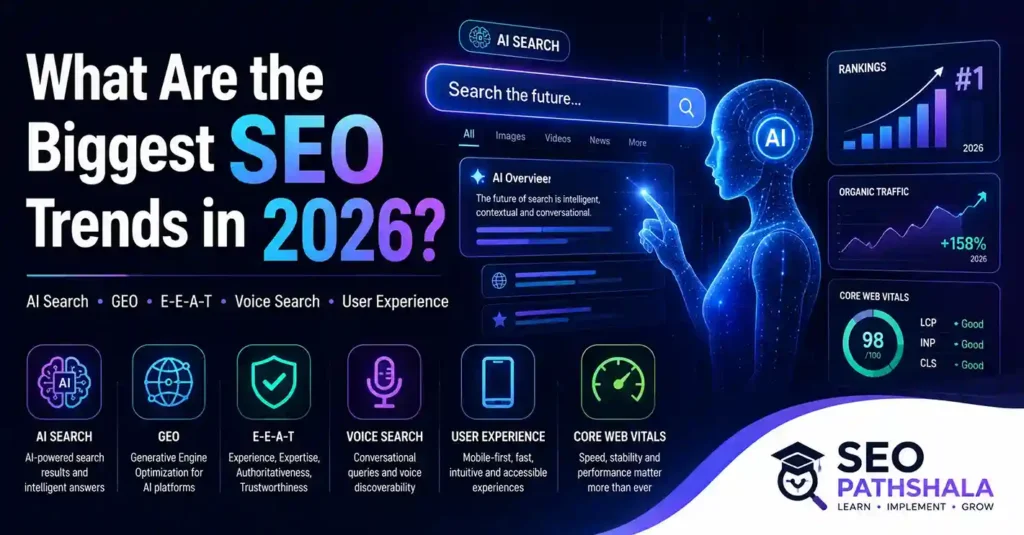
The five trends below are not predictions — they are already reshaping search behaviour right now. Here is what matters and why.
Trend 1: AI Overviews Are Rewriting the Rules of Organic Traffic
Google’s AI Overviews (formerly Search Generative Experience) now appear at the very top of search results for a large share of informational and commercial queries. Instead of showing ten blue links, Google summarises an answer directly on the SERP — pulling content from pages it trusts.
What this means for your business:
- Pages that relied on informational traffic for top-of-funnel visits are seeing reduced click-through rates.
- However, pages that are cited inside an AI Overview get a new kind of high-trust visibility — even if raw traffic dips.
- Google’s own data shows that AI Overviews tend to cite content found in the first 30% of a well-structured article, which is why answer-first writing is critical in 2026.
What to do:
- Answer your primary question within the first 100 words of every blog post.
- Use clear H2/H3 headings that mirror how users phrase queries.
- Write in short, declarative paragraphs — the format AI systems prefer to extract and cite.
- Include original data, examples, or expert opinion that AI cannot generate on its own.
Delhi NCR example: A commercial real estate consultancy in Gurugram restructured their blog posts to lead with a direct answer, then expand. Within two months, three of their articles were cited in AI Overviews for queries like “commercial property investment Gurugram 2026” — driving qualified leads without ranking #1.
Generative Engine Optimization (GEO) is the practice of optimizing your content so that AI search engines — including ChatGPT, Perplexity, Google Gemini, and Bing Copilot — cite your website as a source when answering user questions.
Think of GEO as PR meets SEO. You are not just trying to rank in Google anymore; you are trying to become the source that AI systems trust and reference.
If you want to go deeper on this, read our GEO complete beginner’s guide for 2026 which covers the full framework step by step.
Key GEO signals AI engines look for:
- Author authority — Is the content written or reviewed by a credible expert? Bylines, credentials, and About pages matter.
- Source citation — Do you cite credible external data? AI systems are trained to favour content that references research and authoritative sources.
- Structured, factual writing — Lists, definitions, statistics, and comparison tables are easy for LLMs to extract and cite.
- Brand mentions across the web — If other credible sites reference your brand or content, AI systems are more likely to include you.
- Fresh content — LLMs weigh recency. Stale articles with 2022 data are deprioritised in AI-generated answers.
GEO in practice for Delhi NCR businesses: A CA firm in Noida added detailed FAQ sections, linked to RBI data, and updated their blog posts with 2025–26 figures. Their content began appearing in Perplexity answers for queries like “income tax filing for freelancers India 2026” — a new traffic and credibility channel.
Answer Engine Optimization (AEO) is the discipline of structuring your content so it directly answers natural language questions — the kind users ask Google’s featured snippets, voice search, and AI chatbots.
AEO differs from traditional SEO in one key way: the goal is not to rank #1 and wait for a click. The goal is to be the answer — whether that answer appears in a featured snippet, a voice response, an AI Overview, or a chatbot reply.
How to implement AEO in 2026:
- Target “People Also Ask” queries. Every blog post should address 3–5 PAA questions in its FAQ section with concise, 40–60 word answers.
- Use structured data (FAQ schema). FAQ schema makes it significantly easier for Google and AI systems to parse your Q&A content. Always implement it on content-heavy posts.
- Write in question-answer format. Use H3 headings phrased as questions (e.g., “What is GEO in SEO?”) and answer immediately in the following paragraph.
- Keep answers under 50 words where possible for featured snippet and voice search eligibility.
AEO is particularly powerful for local service businesses in Delhi NCR — people frequently ask queries like “which is the best SEO agency in Faridabad?” or “how much does SEO cost in Delhi?” Businesses that have AEO-optimized pages for these queries can capture the answer layer before competitors even appear.
Working with an SEO expert in Delhi NCR who understands AEO and structured data implementation can significantly accelerate your visibility in both traditional search and AI-generated answers.
Trend 4: Zero-Click Search Is Expanding — and Requires a Strategy Shift
In 2026, a significant share of Google searches end without a single click. Users get their answer directly from the SERP — via featured snippets, knowledge panels, local packs, AI Overviews, or People Also Ask boxes.
This is not a reason to panic. It is a reason to rethink what “winning” looks like in search.
The zero-click reality:
- Informational queries (definitions, how-tos, quick facts) are the most impacted.
- Transactional and local queries still drive clicks — users need to book, buy, or call.
- Brand awareness is built even when users don’t click — your name appearing repeatedly in AI answers creates recognition and trust.
How to adapt your strategy:
- Double down on branded search. Create content that gets your brand name mentioned in AI answers, not just your URL.
- Optimize for the local pack. For Delhi NCR businesses, appearing in Google’s 3-pack for “near me” and city-specific queries still drives direct calls and footfall.
- Prioritize bottom-of-funnel content. Case studies, pricing pages, service comparisons, and testimonials still generate high-intent clicks because users must take action.
- Measure impressions alongside clicks. Your GSC data needs to include brand impressions as a KPI, not just sessions.
Trend 5: E-E-A-T Signals Are Now Table Stakes — Not a Bonus
Google’s E-E-A-T framework (Experience, Expertise, Authoritativeness, Trustworthiness) has evolved from a quality guideline to an active ranking and citation signal in 2026. Both Google’s quality raters and AI systems use E-E-A-T proxies to decide whose content to surface.
If your website publishes generic, authorless content — you are at a structural disadvantage.
E-E-A-T improvements that make a measurable difference:
- Bylines with credentials. Every blog post should name the author, their expertise, and ideally link to an author page. For SEO content, mention the practitioner’s experience, certifications, and real-world cases.
- Real examples over stock advice. Generic tips can be generated by AI. Original case studies, client outcomes, and local-market observations cannot.
- Consistent brand presence. Are you mentioned in other credible sources? Guest posts, media mentions, industry citations, and LinkedIn thought leadership all contribute to your perceived authority.
- Technical trust signals. HTTPS, fast Core Web Vitals, updated copyright dates, privacy policy, and contact information are baseline trust requirements.
- Reviews and ratings. For local businesses, Google review signals (quantity, recency, response rate) feed directly into both the local pack algorithm and E-E-A-T assessment.
For Delhi NCR service businesses: E-E-A-T is especially important in YMYL (Your Money or Your Life) sectors — finance, legal, medical, education. If you operate in these spaces, building author authority through structured content and third-party citations is non-negotiable.
Quick Summary: Top 5 SEO Trends in 2026
| # | Trend | Core Action |
|---|---|---|
| 1 | AI Overviews | Answer first, structure well, get cited |
| 2 | GEO | Build authority so AI engines quote you |
| 3 | AEO | Write for the answer layer, not just the rank |
| 4 | Zero-Click Search | Shift KPIs, win local pack and branded queries |
| 5 | E-E-A-T | Real expertise, real authors, real examples |
What Should Delhi NCR Businesses Do Right Now?
These five trends share a common thread: generic SEO no longer works. In 2026, search rewards content that is expert-led, structurally sound, and genuinely useful — content that AI systems can trust to cite.
Here is a practical three-step action plan:
- Audit your existing content — identify posts that rank for informational queries but have no author byline, no FAQ schema, and no answer-first structure. Refresh them.
- Add FAQ schema to your top 10 pages — this is the single fastest win for AEO and AI Overview eligibility.
- Work with an SEO partner who understands the AI search landscape — not just technical checkboxes.
If you want expert help implementing these strategies for your business, speak with an SEO expert in Delhi NCR who is actively working within the 2026 search environment — not teaching tactics from 2022.
Frequently Asked Questions
What is the most important SEO trend in 2026?
The shift to AI-driven search is the defining trend of 2026. Google’s AI Overviews, along with AI search engines like Perplexity and ChatGPT, are changing how content gets discovered. Businesses need to optimize for GEO (Generative Engine Optimization) and AEO (Answer Engine Optimization) alongside traditional SEO.
What is GEO in SEO?
GEO stands for Generative Engine Optimization. It is the practice of structuring and positioning your content so that AI-powered search engines — including Google Gemini, ChatGPT, and Perplexity — cite your website as a trustworthy source when generating answers for users.
What is AEO and how is it different from SEO?
Answer Engine Optimization (AEO) focuses on making your content the direct answer to a user’s question — in featured snippets, voice search, and AI chatbot responses. Traditional SEO focuses on ranking in a list of results. AEO aims to be the answer, not just a result on the page.
Does zero-click search mean SEO is dying?
No. Zero-click search changes what “success” looks like, but it does not eliminate the value of SEO. Brand visibility, local pack rankings, and high-intent transactional queries still drive significant clicks and conversions. The strategy must evolve, not be abandoned.
How does E-E-A-T affect my website rankings in 2026?
E-E-A-T (Experience, Expertise, Authoritativeness, Trustworthiness) is a core signal Google uses to evaluate content quality. Sites with named expert authors, original insights, strong review profiles, and credible third-party mentions perform significantly better — both in traditional rankings and in AI citation eligibility.
Conclusion
If you’re looking for a quick summary of the most impactful updates, check out our guide covering the top 5 SEO trends every business must know, including AI, GEO, and AEO.

Abhay Saxena is an experienced SEO strategist, digital marketing consultant, and founder of SEO Pathshala, based in Delhi, India. With over 7 years of hands-on experience in Search Engine Optimization, he has helped businesses enhance their online visibility, improve organic rankings, and achieve measurable growth through structured and data-driven SEO frameworks.
His core expertise includes Technical SEO, Local SEO, Core Web Vitals optimization, Google Search Console strategy, GA4 analytics insights, and AI-powered search optimization including AEO (Answer Engine Optimization) and WebMCP integration.
Abhay is passionate about simplifying complex SEO concepts and regularly shares practical tutorials, industry insights, and real-world strategies through SEO Pathshala. His mission is to empower marketers, entrepreneurs, and business owners with sustainable SEO strategies that align with the evolving AI-first search ecosystem.