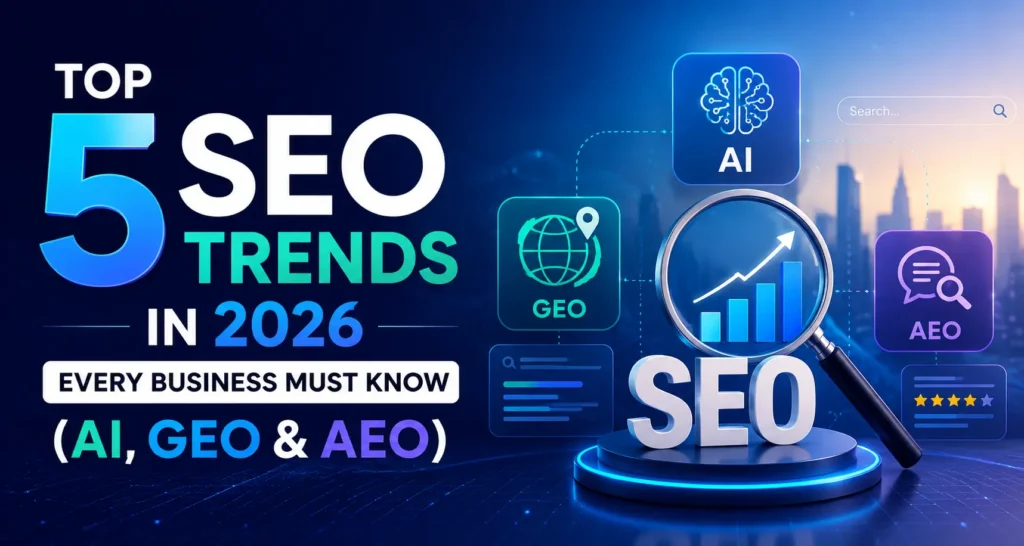
Top 5 SEO Trends in 2026 Every Business Must Know (AI, GEO & AEO)
Search in 2026 doesn’t look like search in 2020 — or even 2024. Google’s AI Overviews now answer a huge share of queries directly on the results page, ChatGPT and Perplexity have become genuine discovery channels for products and services, and voice assistants are answering “near me” questions before a user ever taps a link. If your SEO strategy is still built entirely around ranking ten blue links, you’re optimizing for a search engine that’s already changing shape.
Table of Contents
ToggleThe good news: the businesses that adapt now — before AI-driven search becomes the default rather than the exception — will have a real head start. Below are the five biggest SEO trends shaping 2026, why each one matters, and what you can actually do about it. If you’d rather have a working SEO expert in Delhi NCR handle the implementation while you run your business, that’s exactly the kind of work we do at SEO Pathshala.
1. AI Overviews and AI Search Are Rewriting the SERP
Google’s AI Overviews now appear on a significant portion of informational and commercial-investigation searches, sitting above the traditional organic results and often above ads too. For many queries, users get their answer without scrolling — and without clicking through to any website at all. This is the single biggest structural shift in search since mobile-first indexing, and it’s why “zero-click search” has moved from a buzzword to a budget line item.
What this means practically is that ranking #1 in the classic sense is no longer the finish line. Being the source Google’s AI pulls from — and being cited by name inside that AI-generated answer — is often more valuable than a traditional top-three ranking, because it puts your brand in front of the user even when they never visit your site.
What to do about it:
- Structure content so the direct answer to the main query appears in the first 100 words. AI systems tend to pull from the top of a page, not buried paragraphs.
- Use clear H2/H3 questions that mirror how people actually ask things (“What is local SEO?” rather than “Understanding Local SEO Fundamentals”).
- Back claims with specific numbers, dates, and named sources — AI Overviews favor content that reads as verifiable, not vague.
- Keep technical SEO fundamentals (crawlability, page speed, structured data) tight, because AI systems still rely on a well-indexed, well-structured site to source their answers from.
It’s also worth tracking a new metric alongside your usual rankings and traffic reports: AI citation share — how often your brand shows up inside AI Overviews and chatbot answers for your target queries. Traffic from these surfaces won’t always show up cleanly in Google Analytics, but brand mentions, direct traffic upticks, and branded search volume are early indicators that your content is being pulled into AI-generated answers even without a click.
2. Generative Engine Optimization (GEO) Becomes Non-Negotiable
If AI Overviews are Google folding AI into its own results page, Generative Engine Optimization is the broader discipline of getting your brand cited inside AI-generated answers everywhere — ChatGPT, Perplexity, Google’s AI Overviews, Copilot, and whatever launches next. GEO isn’t a replacement for SEO; it’s an extension of it, built around a simple truth: these tools don’t crawl the web the way Google’s classic algorithm does, and they don’t rank pages — they synthesize answers from multiple sources and decide, on the fly, which brands are worth mentioning.
This is exactly why so many businesses are still confused about where to even start. If you want the full breakdown — how generative engines actually select sources, what “citability” means in practice, and a step-by-step framework to get your content referenced by AI tools — we’ve covered it in detail in our complete beginner’s guide to Generative Engine Optimization for 2026.
At a high level, GEO in 2026 comes down to a few consistent principles:
- Write in a citable format. Short, self-contained, factually dense paragraphs get quoted far more often than long narrative prose.
- Establish topical authority, not just keyword coverage. Generative engines weigh how comprehensively a domain covers a subject, not just whether a single page ranks for one keyword.
- Earn mentions off-site, too. AI models draw on Reddit threads, review sites, comparison articles, and industry publications — not just your own website. Digital PR and community presence now double as GEO signals.
- Keep information current. Generative engines are sensitive to freshness; stale statistics and outdated pricing get quietly dropped from citations.
For businesses in Delhi NCR specifically, this is a genuine opportunity — most local competitors haven’t touched GEO yet, which means the brands that move first are the ones most likely to get cited when someone asks an AI tool “who’s a good SEO agency in Delhi.”
It’s also worth being clear-eyed about what GEO doesn’t change: you still need a fast, crawlable, well-linked website. Generative engines are trained on and reference the same underlying web that traditional search engines index, so a site with technical problems will struggle to get cited regardless of how well the content itself is written.
3. Answer Engine Optimization (AEO) Takes Center Stage
Closely related to GEO — but distinct enough to deserve its own strategy — is Answer Engine Optimization. Where GEO is about being cited inside generative AI responses, AEO is about structuring your content so it can be pulled directly as the answer, whether that’s a featured snippet, a voice assistant’s spoken reply, a “People Also Ask” box, or an AI Overview’s direct quote.
AEO has been building for years through featured-snippet optimization, but 2026 is the year it becomes a formal, standalone part of any serious content strategy. We go deep into the tactics — question-based content structuring, schema markup, and the exact formatting patterns that get pulled into answer boxes — in our dedicated guide to Answer Engine Optimization .
A few AEO fundamentals worth acting on immediately:
- Answer one question per section. Don’t bury three answers inside one sprawling paragraph; answer engines extract cleanly-scoped chunks of text.
- Use FAQ schema and Article schema. Structured data doesn’t guarantee a citation, but it makes it far easier for machines to parse exactly what your content is answering.
- Match question phrasing to real search behavior. Tools like Google’s “People Also Ask” and AlsoAsked reveal the exact wording people use — mirror that phrasing in your headings.
- Optimize for voice, not just text. Voice queries tend to be longer and more conversational (“what’s the best local SEO agency near me”) than typed queries, so your answer content should read naturally out loud.
Think of AEO as writing for two audiences at once: a human skimming for a quick answer, and a machine trying to extract exactly one clean, quotable fact from your paragraph. Content that tries to do both — a direct answer up top, followed by supporting detail and nuance — tends to outperform content optimized for either audience alone.
4. E-E-A-T and Human-First Content Matter More, Not Less
There’s a common misconception that AI-driven search rewards AI-written content. In practice, the opposite is happening. As the web fills up with generic, AI-generated articles, Google and the major AI models are getting noticeably better at identifying — and deprioritizing — content that reads as templated or unoriginal. Experience, Expertise, Authoritativeness, and Trustworthiness (E-E-A-T) has quietly become the filter that separates content worth citing from content that gets ignored.
In 2026, “experience” is doing the heavy lifting in that acronym. Google’s own guidance has increasingly emphasized first-hand experience — has the author actually used the product, run the audit, managed the campaign, visited the location? Generic definitions and rewritten competitor content don’t clear that bar anymore, and AI systems are trained to prefer sources that demonstrate real expertise over sources that simply repeat consensus information.
Practical steps that hold up in 2026:
- Publish content under a named author with a real bio, credentials, and a visible track record — not “Admin” or a generic byline.
- Include original data: your own case studies, screenshots, before/after results, or client examples, even small ones.
- Add genuinely useful detail that competitor articles skip — a specific tool setting, a real cost figure, an edge case you’ve personally run into.
- Keep your Google Business Profile, LinkedIn, and off-site mentions consistent with your on-site author information; AI systems increasingly cross-reference these signals to judge authenticity.
The practical upshot is that “content at scale” strategies built purely on AI generation are becoming a liability rather than an asset. A smaller volume of genuinely experienced, well-attributed content is consistently outperforming larger volumes of generic material — both in traditional rankings and in AI citation rates.
5. Hyper-Local and Zero-Click Optimization for "Near Me" Search
For small and mid-sized businesses especially, the local search experience has changed as much as informational search. AI Overviews are now appearing on local and “near me” queries, Google Maps is surfacing more contextual, review-driven answers, and a growing share of local searches end without a single click to a website — the user gets what they need from the map pack, the knowledge panel, or a spoken voice response.
That makes optimizing for visibility inside these zero-click surfaces just as important as optimizing your website itself. A business that dominates its Google Business Profile, review volume, and local citations can win real customers even if its website ranking is only average — while a business with a well-optimized site but a neglected GBP listing is invisible exactly where local intent is strongest.
If you want the fuller picture — including the other shifts we’re tracking across technical SEO, content strategy, and search behavior heading into 2026 — our earlier analysis on the biggest SEO trends in 2026 is a useful companion read alongside this list.
What actually moves the needle for local visibility right now:
- Keep your Google Business Profile complete, active, and updated with fresh posts and photos — stale listings lose visibility.
- Actively generate and respond to reviews; review recency and response rate are now meaningful ranking and citation signals.
- Build consistent NAP (Name, Address, Phone) citations across local directories — inconsistency quietly erodes local trust signals.
- Add LocalBusiness schema so both traditional search and AI tools can confidently identify your location, hours, and service area.
Where This Leaves Businesses in 2026
None of these five trends work in isolation. AI Overviews, GEO, and AEO are really three expressions of the same underlying shift: search engines are moving from “here are ten links” to “here’s the answer,” and the businesses that get cited inside that answer are the ones who structured their content, their authority, and their local presence to be citable in the first place. Traditional SEO fundamentals — site speed, crawlability, backlinks, keyword research — haven’t disappeared; they’re the foundation everything else sits on. What’s changed is what you build on top of that foundation.
For most businesses, the realistic path forward isn’t chasing every trend at once. It’s picking the two or three that matter most for your specific business — often GEO/AEO content structuring and local optimization together — and executing them properly before spreading attention thinner.
Frequently Asked Questions
What is the biggest SEO trend in 2026?
AI-driven search — specifically Google’s AI Overviews combined with the rise of Generative Engine Optimization (GEO) — is the single biggest shift, because it’s changing how and where users get answers, not just how pages rank.
Is traditional SEO still relevant in 2026?
Yes. Technical SEO, keyword research, and backlinks remain the foundation that GEO and AEO are built on top of. AI search systems still rely on a crawlable, well-structured, authoritative site to source information from.
What's the difference between GEO and AEO?
GEO (Generative Engine Optimization) focuses on getting your brand cited inside AI-generated answers from tools like ChatGPT and AI Overviews. AEO (Answer Engine Optimization) focuses on structuring content to be pulled directly as the answer — in featured snippets, voice responses, or People Also Ask boxes. They overlap heavily and are best approached together.
Do small businesses need to worry about AI search trends?
Yes, arguably more than large brands. Local, zero-click search behavior — where users get an answer without visiting a website — directly affects how visible a small business is on “near me” and local intent searches, regardless of website ranking.
How can a business start adapting its SEO strategy for 2026?
Start by auditing whether your content directly answers user questions in the first 100 words, whether your Google Business Profile is complete and active, and whether your site has basic Article/FAQ schema in place. From there, build out GEO and AEO-specific content structuring.
Need help putting these trends into practice?
Staying visible across traditional search, AI Overviews, and generative engines takes a coordinated strategy — not guesswork. Get in touch with SEO Pathshala for a tailored SEO roadmap built for how search actually works in 2026.

Abhay Saxena is an experienced SEO strategist, digital marketing consultant, and founder of SEO Pathshala, based in Delhi, India. With over 7 years of hands-on experience in Search Engine Optimization, he has helped businesses enhance their online visibility, improve organic rankings, and achieve measurable growth through structured and data-driven SEO frameworks.
His core expertise includes Technical SEO, Local SEO, Core Web Vitals optimization, Google Search Console strategy, GA4 analytics insights, and AI-powered search optimization including AEO (Answer Engine Optimization) and WebMCP integration.
Abhay is passionate about simplifying complex SEO concepts and regularly shares practical tutorials, industry insights, and real-world strategies through SEO Pathshala. His mission is to empower marketers, entrepreneurs, and business owners with sustainable SEO strategies that align with the evolving AI-first search ecosystem.