
Top 10 SEO Mistakes That Kill Your Rankings
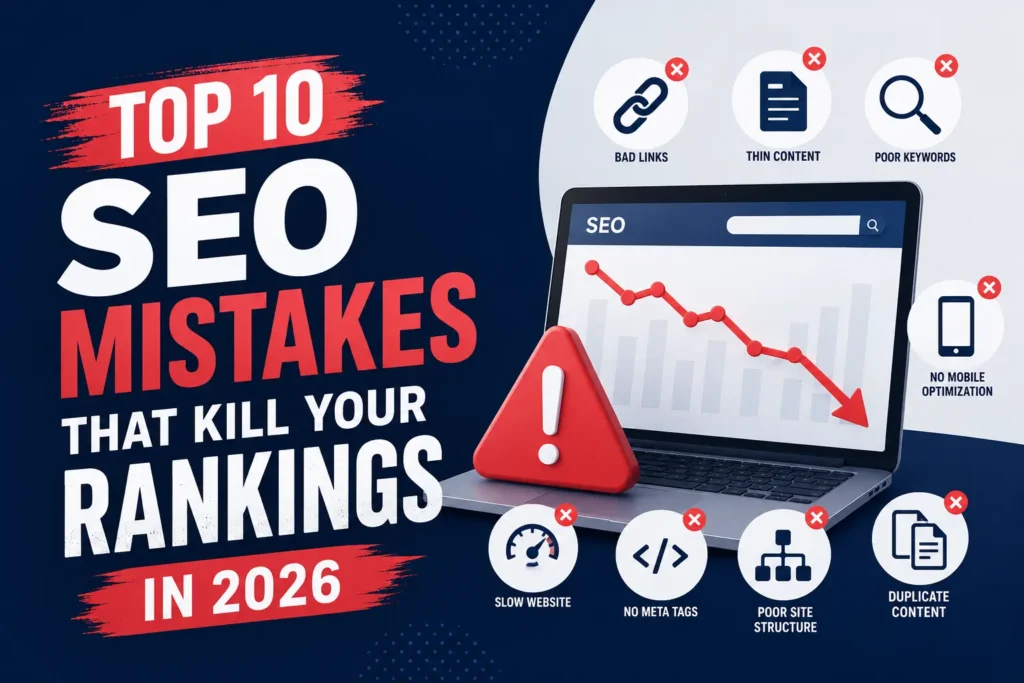
Most ranking drops aren’t caused by a Google update — they’re caused by ten fixable mistakes: ignoring search intent, weak title tags, poor technical health, keyword stuffing, spammy backlinks, weak local SEO, thin content, no internal linking, slow mobile pages, and ignoring AI-driven search. If your traffic has plateaued or slipped, chances are one or more of these is quietly working against you. None of them happen overnight — they build up over months until a site that once ranked comfortably on page one starts sliding without any obvious trigger. Below, we break down each one — why it hurts, and exactly how to fix it.
Table of Contents
ToggleQuick Self-Check: Are You Making These Mistakes?
Run through this checklist against your own site before you close the tab.
| # | Self-Check Question | Yes / No |
|---|---|---|
| 1 | Does your top content actually match what searchers want, or just the keyword? | ☐ |
| 2 | Is every title tag and meta description on your site unique? | ☐ |
| 3 | Have you checked Search Console for crawl or indexing errors this month? | ☐ |
| 4 | Does your content read naturally, or does it feel keyword-stuffed? | ☐ |
| 5 | Have you reviewed your backlink profile for spammy or irrelevant links recently? | ☐ |
| 6 | Is your Google Business Profile fully filled out and consistent with your website’s NAP details? | ☐ |
| 7 | When did you last update your oldest, highest-traffic pages? | ☐ |
| 8 | Do your pages link to other relevant pages and services on your own site? | ☐ |
| 9 | Does your site load quickly and display cleanly on mobile? | ☐ |
| 10 | Is your content structured clearly enough for AI search tools to summarize accurately? | ☐ |
1. Ignoring Search Intent
You can target a keyword perfectly and still lose rankings if your page answers the wrong question. Writing a product page for a keyword that’s actually informational — or a shallow blog post for a keyword people expect a detailed guide on — signals a mismatch Google corrects quickly. A Delhi NCR gym chain, for example, might rank a “gym membership Delhi” page for “best home workout without equipment” and wonder why it never moves past page three — the intent behind those two searches is completely different.
Pro tip: Before writing, Google the keyword yourself. Note whether the top 10 results are guides, product pages, comparisons, or videos, then match that format — and go deeper than what’s already ranking.
2. Weak or Duplicate Title Tags and Meta Descriptions
Title tags and meta descriptions still drive click-through rate, and CTR compounds your ranking advantage — the #1 organic result alone <cite index=”48-1″>captures more clicks than positions 3 through 10 combined</cite>. Duplicate titles across pages also confuse Google about which page should rank for a query.
The fix: Write a unique title for every page, and keep it in the 40–60 character range — <cite index=”45-1″>titles in this range see roughly 33% higher CTR</cite> than titles that get truncated on desktop or mobile. Pair it with a specific, benefit-led meta description under 155 characters.
3. Neglecting Technical SEO and Regular Audits
Great content can’t rank if Google can’t crawl or index it properly. Slow pages, broken internal links, missing sitemaps, and accidental noindex tags are silent killers most business owners never check until traffic has already dropped.
The fix: Run a technical audit every month using Google Search Console plus a crawler tool. Check the Coverage and Page Experience reports for crawl errors, orphaned pages, and indexing drops before they snowball into a full ranking issue. If you’re not sure where to start, this roundup of free SEO tools you should use in 2026 covers exactly what to run and how to read the results — most of it takes under an hour a month once you have a routine.
4. Keyword Stuffing
Keyword stuffing hasn’t worked for years, yet it’s still shockingly common. Repeating a phrase unnaturally throughout a page doesn’t just read badly — Google’s language models are now very good at detecting manipulation and quietly deprioritizing it.
The fix: Write for the reader first. Use your primary keyword in the title, one H2, and the intro, then lean on related terms and natural phrasing everywhere else.
5. Building Low-Quality or Spammy Backlinks
Backlinks remain one of Google’s strongest signals, but the wrong ones hurt more than no links at all. Bulk-bought links, link farms, and irrelevant directory listings can trigger algorithmic devaluation or a manual action that erases months of progress overnight.
The fix: Earn links from relevant, credible sites through guest posts, digital PR, and content worth referencing — one link from a trusted site beats fifty from spam directories. It’s also worth reviewing your existing backlink profile periodically through Google Search Console or a paid tool, since links you didn’t build (from scraper sites, comment spam, or old directory submissions) can accumulate without your knowledge. Auditing and disavowing toxic links is genuinely technical work, and if your backlink profile needs a cleanup, our team can fix your SEO with expert help before it costs you more rankings.
6. Overlooking Local SEO Signals
For a Delhi NCR business, this is often the costliest mistake on the list. Inconsistent NAP (Name, Address, Phone) data across directories, an unclaimed or half-filled Google Business Profile, and zero location-specific content keep you invisible in the map pack — even when your organic pages rank decently. We’ve seen local service providers in Gurugram and Noida lose map pack visibility simply because their business was listed under three slightly different addresses across JustDial, Google, and their own website footer — a small inconsistency that quietly erodes the “prominence” signal Google uses to rank local results.
The fix: Fully optimize your Google Business Profile, keep your business details identical everywhere they’re listed, and build local citations. This guide to Local SEO tips to rank on Google Maps in 2026 walks through GBP setup, review generation, and citation building step by step — and it’s worth understanding how Local SEO impacts businesses overall before you build out a strategy.
7. Thin or Outdated Content
Short, surface-level pages that never get updated lose ground slowly but steadily. Google increasingly rewards comprehensive, current pages — especially for competitive keywords where searchers expect real depth, not a rehashed definition.
The fix: Audit your content library twice a year. Expand thin pages, refresh statistics and examples, and merge duplicate posts targeting the same keyword. Pages that have slipped from page one to page two are often your fastest win — they usually need a refresh, not a rebuild. Keep a simple spreadsheet tracking publish dates and last-updated dates so nothing quietly goes stale without you noticing.
8. Poor Internal Linking Structure
Internal linking is one of the most underused SEO levers. Many sites either skip it entirely or link randomly, making it harder for Google to understand site structure and for visitors to find related content — which hurts both crawl efficiency and time-on-site. Orphaned pages with zero internal links pointing to them are especially common on older sites that have published content for years without ever revisiting the structure.
The fix: Link relevant pages to each other using descriptive, varied anchor text — never “click here,” and never the same anchor twice. Every page should link to at least one other relevant page and one relevant service page on your site, and it’s worth doing a full site crawl once a year specifically to find and fix orphaned pages.
9. Ignoring Mobile Experience and Page Speed
Mobile-first indexing makes this non-negotiable: a slow or clunky mobile experience drags down your desktop rankings too. Yet <cite index=”49-1″>fewer than half of all sites currently meet Google’s Core Web Vitals standards on mobile</cite>, which means this is still an easy win against competitors who haven’t fixed it.
The fix: Compress images, use reliable hosting, remove intrusive pop-ups, and check your Core Web Vitals report regularly — pay particular attention to Largest Contentful Paint and Cumulative Layout Shift, since both are heavily weighted in how Google judges real-world usability.
10. Not Adapting to AI-Driven Search
Search behavior is shifting quickly. AI Overviews and chat-based search assistants are reshaping how answers get surfaced, and businesses optimizing only for traditional blue links are already losing visibility. Recent analysis found that pages ranking #1 organically <cite index=”45-1″>see roughly a 58% drop in click-through rate</cite> when an AI Overview appears above them — a gap that’s only closing for sites structured to be cited directly. This doesn’t mean organic ranking has stopped mattering; if anything, AI Overviews tend to draw heavily from top-ranking pages, which means the fundamentals in mistakes #1 through #9 still decide whether you get cited at all.
The fix: Structure content with clear headings, direct answers, and well-organized data so both search engines and AI systems can parse and cite it accurately. Answer the core question in the first few sentences of every section rather than building up to it — that’s the format AI summaries tend to pull from. This is no longer optional — it’s becoming as fundamental as basic on-page SEO.
Fix Your SEO Before It Costs You More
Start with a clear-eyed audit, prioritize the highest-impact issues first — usually technical health and thin content — and build a habit of revisiting your SEO health regularly instead of treating it as a one-time project. The businesses that recover fastest are rarely the ones with the biggest budgets; they’re the ones that catch these mistakes early and fix them systematically rather than all at once.
If you’d rather have a professional pinpoint exactly which of these ten mistakes is holding your rankings back, get in touch with SEO Pathshala for a full audit, or call now to talk through your site’s current standing.
Frequently Asked Questions
What is the biggest SEO mistake businesses make
Ignoring search intent is usually the most damaging — no amount of technical optimization or backlinks compensates for content that doesn’t answer what the searcher actually needs.
How long does it take to recover rankings after fixing SEO mistakes?
Technical fixes can show improvement within 4–6 weeks, while authority-related issues like weak backlinks or thin content typically take 3–6 months to fully recover.
Can too many backlinks hurt my rankings?
It’s the quality and relevance of backlinks that matters, not the volume. A large number of low-quality or spammy links can trigger a penalty, while fewer high-authority, relevant links perform better.
Is keyword stuffing still a risk in 2026?
Yes. Google’s language models detect unnatural keyword repetition far more reliably than they did a few years ago, making keyword stuffing both ineffective and risky.
Does ranking well organically still matter if AI Overviews are taking clicks?
Yes — organic ranking still feeds AI Overviews and citations, so weak on-page SEO or poor structure can get you skipped by AI answers even if you rank on page one traditionally.

Abhay Saxena is an experienced SEO strategist, digital marketing consultant, and founder of SEO Pathshala, based in Delhi, India. With over 7 years of hands-on experience in Search Engine Optimization, he has helped businesses enhance their online visibility, improve organic rankings, and achieve measurable growth through structured and data-driven SEO frameworks.
His core expertise includes Technical SEO, Local SEO, Core Web Vitals optimization, Google Search Console strategy, GA4 analytics insights, and AI-powered search optimization including AEO (Answer Engine Optimization) and WebMCP integration.
Abhay is passionate about simplifying complex SEO concepts and regularly shares practical tutorials, industry insights, and real-world strategies through SEO Pathshala. His mission is to empower marketers, entrepreneurs, and business owners with sustainable SEO strategies that align with the evolving AI-first search ecosystem.