Top 10 On-Page SEO Factors That Still Matter in 2026
The on-page SEO factors that still matter most in 2026 are title tags, meta descriptions, header hierarchy, keyword and search-intent alignment, content quality and E-E-A-T, internal linking, image optimization, URL structure, structured data, and answer-first content formatting for AI search and AI Overviews.
Table of Contents
Toggle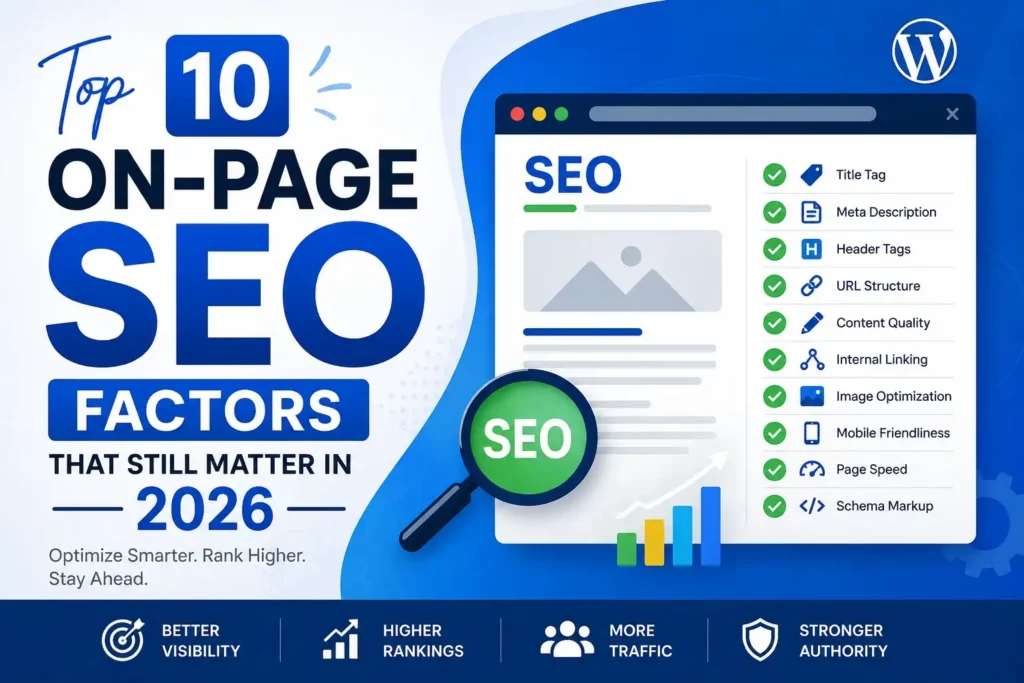
On-page SEO gets declared “dead” every couple of years — and every time, the sites that actually optimize these fundamentals keep outranking the ones that don’t. In 2026, the list has grown slightly: alongside the classic factors, how you structure content for AI Overviews and generative answer engines now directly affects visibility. Here’s exactly what to get right, and why each factor still moves the needle.
Does On-Page SEO Still Matter in 2026?
Yes — and arguably more than it did a few years ago. Google’s core ranking systems still rely heavily on-page signals to understand relevance, and AI Overviews and generative answer engines pull directly from well-structured on-page content when deciding what to cite. The difference in 2026 isn’t that on-page SEO stopped working; it’s that sloppy or templated on-page work is punished faster, because both traditional ranking algorithms and AI summarization systems are better at detecting thin or unclear content than they used to be.
If you want these factors implemented properly across your site rather than fixed one page at a time, complete SEO services in Delhi NCR can handle the full on-page audit and rollout — but the ten factors below are exactly what to prioritize either way.
The 10 On-Page SEO Factors That Still Drive Rankings
1. Title Tag Optimization
Your title tag is still the single strongest on-page relevance signal Google uses, and it’s also the first thing a searcher (or an AI system summarizing search results) reads. Keep your primary keyword near the front, stay under roughly 60 characters so it doesn’t get truncated, and write for click-through — not just keyword stuffing.
2. Meta Description
Meta descriptions don’t directly influence rankings, but they influence click-through rate, which does affect performance over time. A well-written meta description under 160 characters that clearly states what the page delivers consistently outperforms a vague or auto-generated one.
3. Header Tag Hierarchy (H1–H3)
A clean, logical header structure — one H1, followed by properly nested H2s and H3s — helps both search engines and AI crawlers understand how your content is organized. This has become more important for AEO specifically: AI Overviews frequently pull the text directly beneath a clearly worded H2 or H3 question as the answer they display.
4. Keyword Placement & Search Intent Alignment
Where you place keywords matters less than whether your content actually matches what the searcher wants. A page targeting “on-page SEO factors” needs to open by answering that query directly — not build up to it after three paragraphs of introduction. Misaligned intent is one of the most common reasons well-written content still fails to rank.
5. Content Quality, Depth & E-E-A-T
Google’s E-E-A-T framework (Experience, Expertise, Authoritativeness, Trustworthiness) continues to shape how content gets evaluated, especially for topics where accuracy matters. Demonstrating real experience — specific examples, original insights, a named author with relevant credentials — outperforms generic, AI-templated content that reads the same as everyone else’s.
6. Internal Linking Structure
Strategic internal links — pointing to relevant service pages and related blog content, with descriptive (not generic “click here”) anchor text — help distribute authority across your site and guide both users and crawlers to related content. A page with zero internal links pointing to or from it is significantly harder for Google to prioritize.
7. Image Optimization
Descriptive file names, compressed file sizes, and accurate alt text all contribute to on-page SEO — alt text in particular helps with accessibility and gives search engines additional context about page content, while compression directly affects Core Web Vitals and page speed.
8. URL Structure
Short, readable, keyword-relevant URLs (avoiding strings of numbers or unnecessary parameters) are easier for users to trust and easier for search engines to parse. A clean URL structure across a site also makes it easier to spot duplicate or thin content issues during an audit.
9. Structured Data (Schema Markup)
Adding accurate schema — Article, Product, LocalBusiness, or FAQ-style content depending on the page — gives search engines and AI systems an explicit, machine-readable description of what the page contains, rather than requiring them to infer it. This has become one of the more advanced on-page factors, and one of the most directly tied to AI Overview and GEO visibility.
The newest on-page factor: structuring key sections so they open with a direct, self-contained answer (typically 30–60 words) before expanding into detail. This single change is often the difference between a page getting cited inside an AI Overview or a ChatGPT response, and getting skipped in favor of a competitor who formatted their answer more clearly.
On-Page SEO Checklist: Where to Start
If you’re auditing an existing site, start with title tags and header hierarchy (fastest to fix, highest impact), then move to content quality and search intent alignment, and finish with structured data and answer-first formatting. If you’re still making basic on-page errors, it’s worth reviewing Top 10 SEO Mistakes That Kill Your Rankings alongside this list — several of the most damaging mistakes are on-page issues in disguise.
Frequently Asked Questions
Does on-page SEO still matter in 2026?
Yes. On-page factors remain core inputs to how Google and AI search systems determine relevance and decide what to cite — sites that skip these fundamentals consistently underperform sites that get them right.
What are the most important on-page SEO factors?
Title tags, header hierarchy, content quality and search intent alignment, internal linking, and structured data tend to have the largest individual impact, though all ten factors work together.
What's the difference between on-page and off-page SEO?
On-page SEO covers everything you control directly on your website — content, tags, structure, and code. Off-page SEO covers external signals like backlinks, citations, and brand mentions from other sites.
How often should I update on-page SEO?
Review title tags and content accuracy every 6–12 months, and audit technical on-page elements (schema, internal links, page speed) whenever you publish new content or notice a ranking drop.
Does on-page SEO affect AI Overviews and GEO?
Yes — clear header structure, answer-first formatting, and structured data are the on-page factors most directly tied to whether AI Overviews and generative engines cite your content.

Abhay Saxena is an experienced SEO strategist, digital marketing consultant, and founder of SEO Pathshala, based in Delhi, India. With over 7 years of hands-on experience in Search Engine Optimization, he has helped businesses enhance their online visibility, improve organic rankings, and achieve measurable growth through structured and data-driven SEO frameworks.
His core expertise includes Technical SEO, Local SEO, Core Web Vitals optimization, Google Search Console strategy, GA4 analytics insights, and AI-powered search optimization including AEO (Answer Engine Optimization) and WebMCP integration.
Abhay is passionate about simplifying complex SEO concepts and regularly shares practical tutorials, industry insights, and real-world strategies through SEO Pathshala. His mission is to empower marketers, entrepreneurs, and business owners with sustainable SEO strategies that align with the evolving AI-first search ecosystem.