
Quality Score Explained: How I Actually Improve It for Clients
Quality Score is Google’s 1-10 rating of how relevant your ads, keywords and landing pages are, and it directly moves your cost per click. This guide breaks down what actually drives it, then walks through the real, repeatable steps I use to raise Quality Score on client Google Ads accounts.
I’m Abhay Saxena, and I manage Google Ads accounts for Delhi NCR businesses alongside SEO work. Most “improve your Quality Score” advice online is generic. This is the process I actually follow, account by account.
Table of Contents
ToggleWhat Is Google Ads Quality Score?
Quality Score is a diagnostic metric, from 1 to 10, that Google assigns to each keyword in your account. It estimates how relevant your ad and landing page are to a person searching that keyword, compared to other advertisers bidding on it.
You’ll find it under the “Quality Score” column in the Keywords view (add the column manually; it’s hidden by default). It isn’t used directly in the real-time auction, but it heavily influences your Ad Rank and, through that, your actual cost per click.
What Are the Three Components of Quality Score?
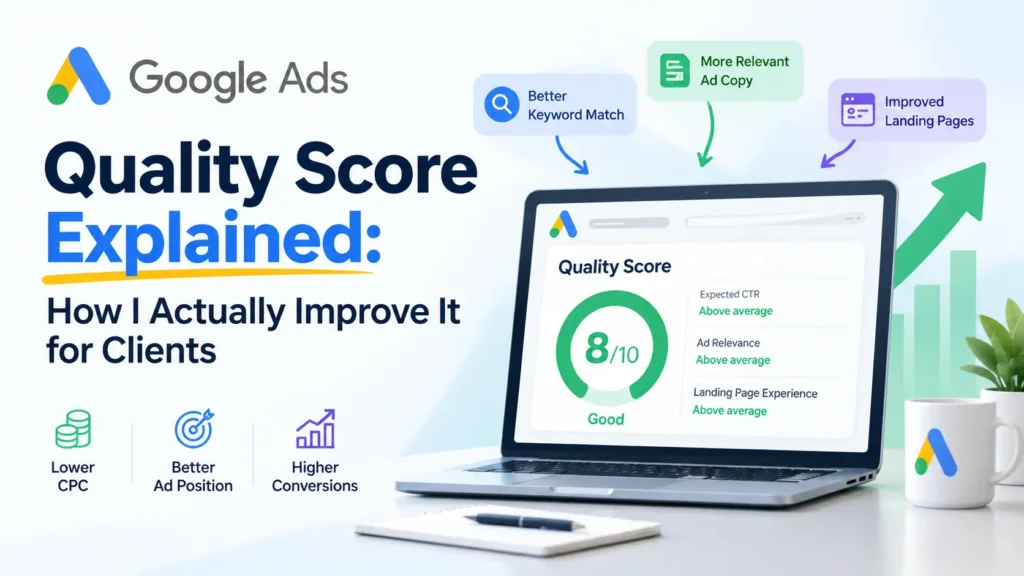
Google breaks the score into three sub-metrics, each rated “Below average”, “Average” or “Above average”. Fixing your Quality Score means fixing whichever of these is dragging it down.
| Component | What It Measures | What Improves It |
|---|---|---|
| Expected CTR | How likely your ad is to get clicked versus competitors, for that keyword | Tighter keyword-to-ad match, compelling ad copy, ad extensions |
| Ad Relevance | How closely your ad text matches the searcher's intent | Smaller, tightly themed ad groups; keyword in headline |
| Landing Page Experience | How relevant, useful and fast your landing page is | Page speed, mobile usability, content matching the ad's promise |
Why Does Quality Score Matter for Your Ad Spend?
A higher Quality Score doesn’t just look good in a report. It changes what you actually pay and what your account can afford to do.
- Lower cost per click: Google effectively discounts your CPC for the same ad position when your Quality Score is higher.
- Better ad positions: Ad Rank is bid multiplied by expected quality, so a strong Quality Score can outrank a higher bidder.
- Ad Strength unlocked: weak relevance signals cap how well Responsive Search Ads can perform.
- More budget efficiency: the same monthly spend buys more clicks and, usually, more conversions.
If you’re deciding whether to invest more in Ads or in organic instead, my comparison of SEO vs Google Ads: Top 5 Differences lays out the cost and timeline trade-offs.
What Is a Good Quality Score?
Context matters more than the raw number, but this is roughly how I read scores across client accounts.
| Score Range | What It Usually Means | Action |
|---|---|---|
| 8–10 | Strong relevance; you’re likely paying less than competitors for the same position | Maintain, keep testing ad copy |
| 5–7 | Average; there’s room to improve one or more components | Diagnose the weak component and fix it |
| 1–4 | Poor relevance; you’re overpaying and may be losing impression share | Restructure the ad group or landing page, don’t just tweak copy |
How Do You Check Quality Score in Your Google Ads Account?
- Open the Keywords page under Campaigns in Google Ads.
- Click the columns icon and add “Quality Score”, “Exp. CTR”, “Ad relevance” and “Landing page exp.”.
- Sort by Quality Score, lowest first, to find the keywords hurting your account most.
- Cross-check spend against those low-scoring keywords; a low score on a low-spend keyword is a lower priority than one on your top spender.
Note that Quality Score needs meaningful impression volume before Google assigns a reliable rating, so brand-new keywords often show “Not enough data” for the first week or two.
How Do I Actually Improve Expected CTR?
This is the component that moves fastest, because it responds directly to ad copy and account structure changes.
- Rewrite headlines so the exact keyword, or a very close variant, appears in at least one headline.
- Add every relevant ad extension: sitelinks, callouts, structured snippets, and call extensions for service businesses.
- Pause the lowest-CTR ad in each ad group and let Google’s optimization favor the stronger one, or test a fresh variant against the winner.
- Remove keywords that are too broad for the ad group; a broad keyword sitting in a tightly themed group drags down its own expected CTR.
How Do I Fix Ad Relevance?
Ad relevance problems almost always trace back to ad group structure, not the ad copy itself. My fix is structural, not cosmetic.
- Split broad ad groups into Single Keyword Ad Groups (SKAGs) or tightly themed clusters of 3-5 closely related keywords.
- Match search intent: separate “buy”, “price” and “near me” variants from purely informational queries, since they need different ad copy.
- Audit search terms weekly and add irrelevant queries as negative keywords before they dilute relevance signals.
For the account-level structure I use before I even get to Quality Score, see my Google Ads Account Structure framework for Delhi NCR SMBs.
How Do I Improve Landing Page Experience?
This is the component clients underestimate most, because it lives outside the Ads platform.
| Landing Page Factor | Fix |
|---|---|
| Page load speed | Compress images, use a caching plugin, minimize third-party scripts (Core Web Vitals fixes carry over here) |
| Mobile usability | Test on an actual phone; check tap targets, font size and form fields |
| Content relevance | The headline and offer on the page must match the ad’s promise exactly, word for word where possible |
| Transparency and trust | Clear business information, contact details and no intrusive interstitials |
| Original, useful content | Enough on-page content to justify the click, not a bare form |
I treat this step the same way I approach organic landing pages; the technical fixes overlap heavily with my Core Web Vitals optimization case study.
What Mistakes Actually Lower Quality Score?
- Sending every ad group to the same generic homepage instead of a matching landing page.
- Running one huge ad group with 30+ loosely related keywords.
- Leaving broad match keywords unchecked without a strong negative keyword list.
- Ignoring mobile page speed while optimizing only the desktop experience.
- Rewriting ad copy repeatedly without ever touching the landing page or ad group structure.
How Long Does It Take to Improve Quality Score?
In my experience, expected CTR and ad relevance changes show movement within 1-2 weeks once a keyword rebuilds enough impression volume. Landing page experience changes, especially speed fixes, can take 2-4 weeks to fully reflect, since Google needs fresh crawl and user data on the updated page.
My Step-by-Step Quality Score Improvement Process
- Export the Keywords report and sort by Quality Score, lowest first.
- Identify which of the three components is weakest for each low-scoring keyword.
- For weak Expected CTR: rewrite headlines and add missing extensions.
- For weak Ad Relevance: split the ad group into tighter keyword clusters.
- For weak Landing Page Experience: fix page speed first, then content match.
- Wait 10-14 days for the score to recalculate with new data.
- Re-check and repeat for the next-lowest scoring keywords.
What Tools Do I Use to Track Quality Score Changes?
Google Ads’ native reporting is enough for most accounts, but a few habits make tracking easier over time.
- Saved column sets: save a custom Keywords view with Quality Score and its three components pinned, so you’re not re-adding columns every session.
- Weekly search terms report: export it every week and scan for irrelevant queries before they weaken ad relevance.
- Google PageSpeed Insights: run every landing page through it after a redesign, since landing page experience depends on real-world speed data, not just lab tests.
- Change history log: Google Ads’ built-in change history helps you match a Quality Score shift to the exact edit that caused it, rather than guessing.
How Does Quality Score Relate to AI Overviews and Google's Broader Ranking Systems?
Quality Score itself only affects paid search. But the underlying signals it rewards, fast pages, clear content matching the query, and genuine relevance, are the same signals that support organic visibility and AI-generated answers. A landing page you fix for Quality Score usually becomes a stronger organic page too, which is why I treat Ads and SEO landing pages under the same quality standard rather than as separate projects.
How Does Quality Score Interact With Smart Bidding?
Automated bid strategies such as Target CPA and Target ROAS don’t display a “Quality Score adjustment” the way manual CPC does, but the underlying relevance signals still shape the auction. Google’s systems account for expected quality in every auction, whether a human or an algorithm sets the bid. In practice, I’ve seen Smart Bidding campaigns stabilize faster and hit target CPAs sooner once the account’s Quality Score foundation, tight ad groups and fast landing pages, is already solid. Fixing Quality Score first, then switching to automated bidding, tends to outperform doing it the other way around.
What Are Common Myths About Quality Score?
| Myth | Reality |
|---|---|
| “Quality Score is used directly in the real-time auction” | The visible 1-10 score is a diagnostic tool; real-time auctions use more granular, per-query quality signals |
| “Raising my bid fixes a low Quality Score” | Bid changes affect Ad Rank, not the underlying relevance components |
| “More keywords in an ad group means more reach” | Loosely grouped keywords dilute ad relevance for every keyword in that group |
| “Quality Score doesn’t matter with Smart Bidding” | The relevance signals behind it still influence how efficiently automated bidding performs |
Frequently Asked Questions
Does a low Quality Score mean my ads won't show?
No. Ads with lower Quality Scores can still run, but they typically cost more per click and may show in lower positions for the same bid.
Can Quality Score vary by device?
Yes. Google calculates separate Quality Score data for mobile and desktop, so a keyword can perform well on one device and poorly on the other.
Does Quality Score affect Performance Max campaigns?
Performance Max doesn’t show a traditional keyword-level Quality Score, but the same underlying relevance and landing page signals still influence performance.
Is a 10 out of 10 Quality Score always achievable?
Not for every keyword. Highly competitive, generic keywords are harder to max out than specific, well-matched long-tail terms.
Should I pause keywords with a Quality Score of 1 or 2?
Not immediately. First check if the ad group and landing page are actually relevant to that keyword; often restructuring fixes the score without losing the keyword.
Does Quality Score reset when I create a new campaign?
Yes, effectively. A newly added keyword starts without enough data for a reliable score, even if an identical keyword performs well elsewhere in the account. It needs fresh impression volume before Google assigns a stable rating.
Can I see Quality Score for Display or Video campaigns?
No. Quality Score, in its 1-10 keyword form, is specific to Search campaigns. Display and Video use different relevance and quality signals that aren’t shown the same way.
Final Thoughts: Quality Score Rewards Structure, Not Just Copy
The accounts I’ve improved the most weren’t fixed with cleverer headlines. They were fixed by matching ad groups tightly to intent and sending traffic to landing pages that actually deliver on the ad’s promise. Start with the keywords costing you the most, diagnose the weak component, and fix that specifically. If you’d rather have this managed for you, see my Google Ads optimization services for Delhi NCR businesses.

Abhay Saxena is an experienced SEO strategist, digital marketing consultant, and founder of SEO Pathshala, based in Delhi, India. With over 7 years of hands-on experience in Search Engine Optimization, he has helped businesses enhance their online visibility, improve organic rankings, and achieve measurable growth through structured and data-driven SEO frameworks.
His core expertise includes Technical SEO, Local SEO, Core Web Vitals optimization, Google Search Console strategy, GA4 analytics insights, and AI-powered search optimization including AEO (Answer Engine Optimization) and WebMCP integration.
Abhay is passionate about simplifying complex SEO concepts and regularly shares practical tutorials, industry insights, and real-world strategies through SEO Pathshala. His mission is to empower marketers, entrepreneurs, and business owners with sustainable SEO strategies that align with the evolving AI-first search ecosystem.