SEO vs Google Ads: Top 5 Differences (And When to Use Each)
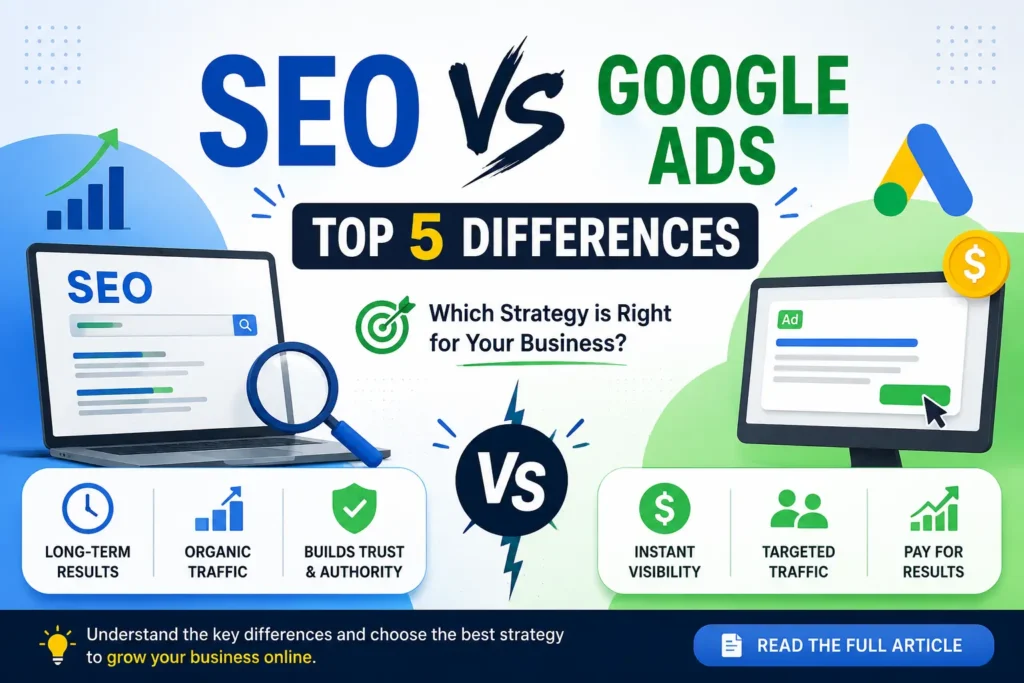
SEO and Google Ads both help you get found on Google, but they work in opposite ways. SEO earns free, long-term organic traffic by improving your site’s relevance and authority, while Google Ads buys instant, top-of-page visibility on a pay-per-click basis. The five biggest differences come down to cost, speed, longevity, control, and trust — SEO is slower but compounding and free per click; Google Ads is instant but stops the moment you stop paying. Most Delhi NCR businesses get the best ROI by running both together, using Ads for quick leads while SEO builds in the background.
Table of Contents
ToggleWhat Is SEO?
SEO (Search Engine Optimization) is the practice of improving your website’s content, structure, and authority so it ranks organically in Google’s unpaid results — without paying per click. It covers technical SEO, on-page content, local SEO, and increasingly, AI-driven search visibility through Generative Engine Optimization (GEO) and Answer Engine Optimization (AEO), which help your content get pulled into AI Overviews, ChatGPT, and Gemini answers.
What Is Google Ads (PPC)?
Google Ads is Google’s pay-per-click (PPC) advertising platform. You bid on keywords, write ad copy, and pay only when someone clicks your ad — which then appears above organic results, on the Search Network, Display Network, YouTube, or Shopping tab. Visibility is immediate, but it lasts only as long as your budget does.
SEO vs PPC vs SEM: Clearing Up the Confusion
Before comparing the two head-to-head, it helps to clear up related terms people search alongside “SEO vs Google Ads” — namely SEO vs PPC and SEO vs SEM. Here’s the distinction:
- PPC (Pay-Per-Click) is the billing model — you pay only when someone clicks. Google Ads is the platform most commonly used to run PPC campaigns, so “Google Ads” and “PPC” are often used interchangeably.
- SEM (Search Engine Marketing) is the umbrella term that technically includes both SEO and paid search, though in everyday use most marketers use “SEM” to mean the paid side only.
- SEO sits outside both — it’s the organic, non-paid side of search visibility.
So whether someone asks “SEO vs PPC,” “SEO vs SEM,” or “SEO vs Google Ads,” they’re really asking the same underlying question this guide answers: organic vs paid search.
SEO vs Google Ads: Quick Comparison Table
| Factor | SEO | Google Ads |
|---|---|---|
| Cost Model | No cost per click; investment in time and strategy | Pay per click (CPC); budget-dependent |
| Time to Results | Typically 3–6 months | Same day to a few hours |
| Longevity | Compounds over time; continues delivering traffic with ongoing maintenance | Traffic stops almost immediately when the advertising budget ends |
| Trust Factor | Higher perceived credibility through organic search rankings | Lower trust for some users because ads are clearly labeled as “Sponsored” |
| Targeting Control | Broad keyword and topical relevance | Precise targeting by keywords, location, device, audience, and schedule |
| Best For | Long-term brand visibility, authority, and sustainable organic traffic | Quick lead generation, product launches, seasonal campaigns, and limited-time offers |
| Skill & Maintenance | Continuous content creation, technical SEO, and link-building efforts | Ongoing bid management, budget optimization, and campaign monitoring |
Difference #1: Cost & Investment Model
This is the difference most business owners ask about first. SEO has no per-click cost — you invest in content, technical fixes, and strategy (either your own time or an agency fee), and the traffic you earn afterward is free. Google Ads charges per click, so your cost scales directly with traffic volume. In competitive categories like legal, real estate, or healthcare in Delhi NCR, CPCs can run anywhere from ₹20 to ₹300+ per click depending on the keyword.
For example, a Google Ads campaign spending ₹25,000/month at an average CPC of ₹50 buys roughly 500 clicks a month — every month, for as long as you keep paying. The same ₹25,000 invested once in a well-optimised SEO page can keep bringing in organic clicks for years with only light maintenance. Over a 12-month period, SEO usually works out cheaper per lead once your rankings stabilise, while Google Ads gives you a predictable, if recurring, cost. If your budget is unpredictable but you need leads now, a professional Google Ads consultant in Delhi NCR can help you avoid overspending on the wrong keywords while you build organic rankings in parallel.
Bottom line: SEO costs more upfront in effort, Google Ads costs more on an ongoing per-click basis.
Difference #2: Speed to Results
Google Ads can put you at the top of page one within hours of launching a campaign — approval usually takes less than a day. SEO takes considerably longer. Even with strong on-page and technical work, most competitive keywords take 3–6 months to show meaningful movement, and highly competitive terms can take longer.
This is why the two are rarely an “either/or” decision for businesses that need leads immediately: Google Ads fills the gap while SEO is still building momentum in the background.
Bottom line: Choose Google Ads when you need leads this week; choose SEO when you’re building for the next 2–3 years.
Difference #3: Longevity of Results (Compounding vs Renting)
Think of Google Ads as renting your visibility — the moment you stop paying, your traffic drops to zero almost instantly. SEO is closer to owning an asset: rankings built through solid on-page and technical SEO tend to persist for months even with reduced activity, and each new well-optimised page adds to your site’s overall authority.
This compounding effect is one reason a structured, long-term SEO consulting services in Delhi NCR engagement often delivers a lower cost-per-lead than Ads by year two — the traffic keeps arriving without an equivalent ongoing spend. That said, SEO isn’t “set and forget”; algorithm updates and competitor activity mean rankings still need periodic upkeep.
Bottom line: Google Ads traffic disappears when you stop paying; SEO traffic degrades slowly and can be maintained at lower cost.
Difference #4: Control, Targeting & Flexibility
Google Ads gives you granular control that SEO simply cannot match: you choose exact keywords, geographic radius, device, time of day, audience demographics, and daily budget — and you can pause or change all of it instantly. This precision is also why so many campaigns underperform; small mistakes like the ones covered in our common Google Ads mistakes that drain ad budget guide can quietly waste thousands of rupees a month.
SEO offers less granular control — you can’t “pause” a keyword ranking or guarantee a specific position — but it lets you build broader topical authority that captures long-tail and voice/AI-driven queries you never explicitly targeted.
Bottom line: Google Ads wins on precision and instant control; SEO wins on breadth and durability.
Difference #5: Trust, Credibility & Click-Through Behaviour
Multiple industry studies on searcher behaviour consistently show that organic results receive a higher share of clicks than paid ads for the same query, largely because users perceive organic rankings as more “earned” and trustworthy, while ads are clearly labelled “Sponsored.” This trust advantage is compounding: strong E-E-A-T signals and AI-search readiness now also influence whether your brand gets cited inside AI Overviews and chatbot answers — something paid ads currently cannot buy.
Google Ads, however, builds a different kind of trust: repeated exposure through remarketing and consistent ad presence builds brand familiarity even among users who don’t click immediately.
Bottom line: SEO builds click-through trust and AI-search citations organically; Google Ads builds repeated brand exposure through paid reach.
Can You Use SEO and Google Ads Together?
Yes — and for most growing businesses, this is the smartest approach rather than picking one. A common working model:
- Month 1–3: Run Google Ads to generate leads immediately while SEO foundations (technical fixes, on-page content, local listings) are being built.
- Month 3–6: Use Google Ads’ Search Terms data to discover high-converting keywords, then target those same terms with SEO content for free, long-term traffic.
- Month 6 onward: As organic rankings mature, gradually shift ad spend toward high-intent, bottom-of-funnel keywords SEO hasn’t captured yet, while SEO covers the broader informational and local queries.
Running both also gives you double visibility on the search results page — appearing as both a paid ad and an organic listing for the same query measurably increases total click share.
When to Use SEO vs When to Use Google Ads
| Choose SEO If… | Choose Google Ads If… |
|---|---|
|
|
💡 Practical tip for Delhi NCR businesses: If you’re a local business — a clinic, salon, institute, or service provider — pairing Google Ads with strong local SEO fundamentals to rank on Google Maps usually outperforms either channel alone, since local intent searches often check both the map pack and the ads before choosing.
Frequently Asked Questions
Is SEO better than Google Ads?
Neither is universally “better” — they solve different problems. SEO is better for long-term, compounding, lower-cost-per-lead traffic. Google Ads is better when you need leads immediately or are testing a new offer. Most businesses benefit from using both strategically.
Which is cheaper: SEO or Google Ads?
Google Ads has a lower upfront cost but an ongoing per-click expense that scales with traffic. SEO requires more upfront investment in strategy and content but typically becomes cheaper per lead over 6–12 months as rankings mature and traffic no longer carries a per-click cost.
Can I do SEO and Google Ads at the same time?
Yes. Running both simultaneously is a common and effective strategy — Google Ads covers immediate lead generation while SEO builds long-term organic visibility, and data from your ad campaigns can guide which keywords to prioritise for SEO content.
How long does SEO take compared to Google Ads?
Google Ads can generate clicks within hours of launch. SEO typically takes 3–6 months to show meaningful ranking improvements, and longer for highly competitive keywords, since it depends on content quality, technical health, and domain authority.
Should a small business start with SEO or Google Ads?
If a small business needs revenue quickly and has a workable ad budget, starting with Google Ads makes sense. If the budget is limited but there’s time to invest, starting with local SEO and foundational content is usually the more sustainable path.
What's the difference between SEO and SEM?
SEM (Search Engine Marketing) technically covers all search visibility strategies, including SEO, but is commonly used to refer only to paid search advertising like Google Ads. SEO refers specifically to organic, unpaid rankings. In practice, “SEO vs SEM” and “SEO vs Google Ads” are usually asking the same question.
Does running Google Ads improve my organic SEO rankings?
Google Ads spend does not directly influence organic rankings — Google has confirmed paid and organic algorithms are separate. However, Ads campaigns indirectly support SEO by revealing which keywords convert, generating brand searches, and providing traffic data you can use to prioritise your SEO content strategy.
Ready to Decide Where to Invest?
Whether you need fast leads through paid search or a long-term organic growth strategy, the right starting point depends on your budget, timeline, and goals. Our team at SEO Pathshala manages both sides of this equation for businesses across Delhi NCR — from Google Ads campaign management to complete SEO strategy and execution. Reach out for a free initial review of your current setup.

Abhay Saxena is an experienced SEO strategist, digital marketing consultant, and founder of SEO Pathshala, based in Delhi, India. With over 7 years of hands-on experience in Search Engine Optimization, he has helped businesses enhance their online visibility, improve organic rankings, and achieve measurable growth through structured and data-driven SEO frameworks.
His core expertise includes Technical SEO, Local SEO, Core Web Vitals optimization, Google Search Console strategy, GA4 analytics insights, and AI-powered search optimization including AEO (Answer Engine Optimization) and WebMCP integration.
Abhay is passionate about simplifying complex SEO concepts and regularly shares practical tutorials, industry insights, and real-world strategies through SEO Pathshala. His mission is to empower marketers, entrepreneurs, and business owners with sustainable SEO strategies that align with the evolving AI-first search ecosystem.