
Inside My SEO Training Program: What Students Actually Learn
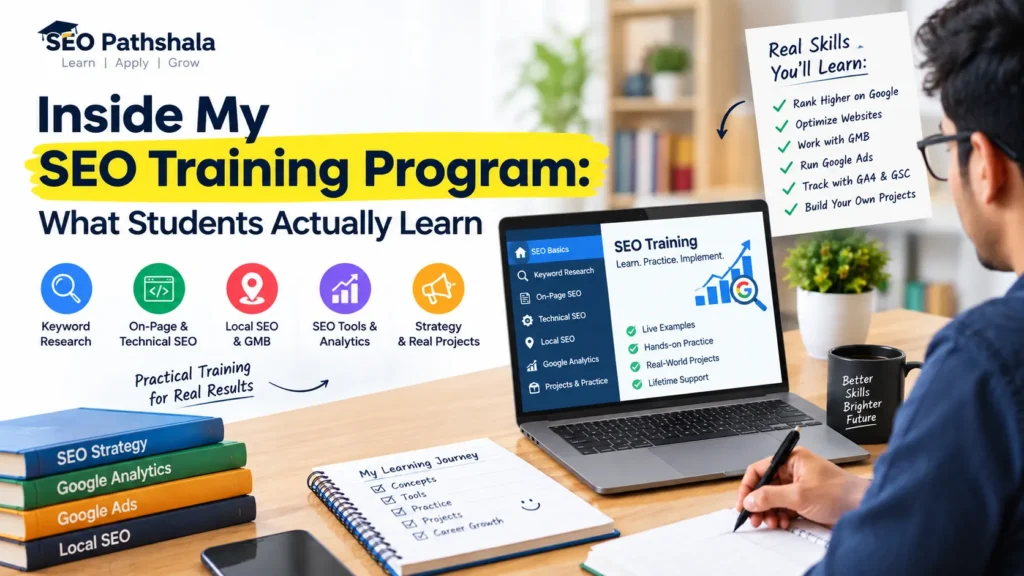
My SEO training program in Delhi teaches practical, hands-on SEO, not just theory, so students can audit real websites and run real campaigns from day one. This guide walks through every module, project and skill students actually leave with, module by module.
I’m Abhay Saxena, founder of SEO Pathshala, and I’ve trained students and working professionals across Delhi NCR for 7+ years. This is an honest, behind-the-scenes look at what happens inside the program, not a marketing pitch.
Table of Contents
ToggleMy Student Sumit Jain Testimony - SEO & Google Search Ads Training
What Is the SEO Training Program at SEO Pathshala?
It’s a structured, instructor-led course that takes students from zero SEO knowledge to running live technical, on-page and local SEO work, taught by a practicing SEO strategist rather than a trainer who only teaches theory.
Classes mix live demonstrations on real client-style websites with hands-on assignments, so every concept is tied to a task students actually complete, not just a slide they watch.
Who Is This SEO Training Program For?
- Complete beginners wanting a career in digital marketing or SEO.
- Working professionals in marketing, content or web development who need SEO skills for their current role.
- Business owners who want to manage their own website’s SEO instead of fully outsourcing it.
- Freelancers and agency owners who want a more technical, defensible skill set for client work.
If you’re still deciding whether a structured course or self-learning makes more sense, my Complete SEO Roadmap for 2026 lays out what to learn and in what order either way.
What Topics Does the SEO Training Program Cover?
The course is built in modules, moving from foundations to the technical and local SEO work that client projects actually demand.
| Module | What Students Learn | Hands-On Project |
|---|---|---|
| SEO Foundations | How search engines crawl, index and rank pages; search intent; the buyer’s journey | Keyword intent mapping exercise |
| Keyword Research | Finding and prioritizing keywords using free and paid tools, search volume, difficulty, intent | Full keyword research sheet for a real niche |
| On-Page SEO | Title tags, meta descriptions, header structure, internal linking, content optimization | On-page audit and fix for a live page |
| Technical SEO | Crawling, indexing, site speed, Core Web Vitals, structured data, mobile usability | Full technical audit using Screaming Frog and Google Search Console |
| Local SEO & GBP | Google Business Profile optimization, citations, local ranking factors, review strategy | Live GBP audit and optimization plan |
| Link Building | Outreach, guest posting, link quality evaluation, avoiding spammy tactics | Outreach pitch and prospect list |
| Google Ads Basics | Campaign structure, Quality Score, how paid search complements organic SEO | Mock campaign build |
| AI Search, GEO & AEO | How AI Overviews, ChatGPT and Gemini surface content; structuring content for answer engines | Rewriting a page for AEO/GEO |
| Reporting & Analytics | GA4, Google Search Console, explaining results to clients or managers | Client-style performance report |
How Is Each Class Structured?
- A short review of the previous class’s assignment, with individual feedback.
- A live demonstration of the day’s concept on a real or sample website, not just slides.
- Guided practice, where students apply the concept immediately with support available.
- An assignment to complete independently before the next class.
- Open Q&A on live account issues students are facing at work, when relevant.
What Tools Do Students Get Trained On?
Theory without tool fluency doesn’t translate into a job-ready skill, so tool training is built into every module.
- Google Search Console and Google Analytics 4
- Screaming Frog SEO Spider for technical audits
- Google Keyword Planner and at least one paid keyword research tool
- Google Business Profile manager
- Google Ads interface, at a foundational level
- PageSpeed Insights and Core Web Vitals reporting
I rely on the same tool stack with clients, which I cover in more depth in Top 10 Free SEO Tools You Should Use in 2026.
What Projects Do Students Complete During the Program?
Every module ends in a deliverable, and students leave with a portfolio, not just notes.
- A complete keyword research sheet for a chosen niche or business.
- A full technical SEO audit report, following the same framework I use with clients.
- A Google Business Profile optimization plan for a real or sample local business.
- An on-page SEO rewrite of an existing underperforming page.
- A final capstone project combining technical, on-page, local and reporting work into one case study.
The technical audit project follows the same structure as my 5-step technical SEO audit framework, and the GBP project mirrors my Complete Google Business Profile Optimization Playbook.
How Long Is the SEO Training Program and What Is the Schedule?
| Detail | Typical Structure |
|---|---|
| Duration | Several weeks, depending on batch pace and depth chosen |
| Format | Live sessions, in-person or online, not pre-recorded videos |
| Batch size | Small, so every student gets direct feedback on assignments |
| Mode | Delhi NCR in-person classes and online live sessions for remote students |
Exact batch dates, fees and current schedule are kept on the SEO training in Delhi page, since these change between cohorts.
What Skills Do Students Walk Away With?
- Running an independent technical SEO audit on any website, not just a template checklist.
- Optimizing and managing a Google Business Profile for local visibility.
- Building and prioritizing a keyword research plan from scratch.
- Structuring content and pages for both classic SEO and AI-driven search (AEO/GEO).
- Reading and explaining GA4 and Search Console data without relying on a third-party dashboard.
- Enough Google Ads literacy to understand how paid and organic search fit together.
For the broader context of how these skills map to a career path, see Top 10 SEO Skills to Learn in 2026.
How Does This Program Prepare Students for SEO Job Interviews?
Because the course is built around real deliverables, students enter interviews with actual audits, reports and case studies to discuss, not just memorized definitions. Pair that portfolio with focused interview preparation using Top 50 SEO Interview Questions and Answers, and students walk in able to explain both the concept and a real example of applying it.
How Does the Program Teach AI Overviews, AEO and GEO?
This module gets more time than most training programs give it, because client work increasingly depends on it. Students learn how AI Overviews, ChatGPT and Gemini select and summarize content, then apply that directly.
- Understanding how answer engines extract definitions, steps and comparisons from a page.
- Structuring a page with a short, direct answer right after the H1, followed by supporting depth.
- Writing question-style headings that match real high-volume search queries.
- Using tables, numbered lists and bullet lists so data is easy for both readers and AI systems to parse.
- Adding FAQ and Article schema so structured data reinforces what the page already states in plain text.
Students apply all of this directly to the rewrite project, turning an existing page into one structured for both traditional rankings and AI-generated answers.
Beginner Track vs Advanced Track: Which Should You Choose?
| Aspect | Beginner Track | Advanced / Professional Track |
|---|---|---|
| Best for | Students with no prior SEO or marketing background | Working professionals, freelancers, agency staff |
| Pace | Slower, with more foundational explanation | Faster, assumes basic digital marketing familiarity |
| Depth on technical SEO | Core concepts and guided practice | Independent audits with less hand-holding |
| Client-facing skills | Introduced at a basic level | Reporting, client communication and pitching emphasized |
Most students start in whichever track matches their current comfort with digital marketing concepts; the course content overlaps heavily, with the difference being pace and depth of independent practice.
What Kind of Support Do Students Get Outside Class Hours?
- Assignment feedback: each submitted project gets individual written or verbal feedback before the next class.
- Doubt-clearing sessions: time set aside specifically for questions on live accounts or confusing concepts.
- Access to templates: the same audit checklists and reporting templates used in real client engagements.
- Post-course guidance: help interpreting results on a student’s own website or early freelance project after the course ends.
Why Learn SEO From a Practicing Strategist Instead of a Full-Time Trainer?
SEO changes constantly, Google algorithm updates, the rise of AI Overviews, and shifting local ranking factors all mean a syllabus written once and taught unchanged for years goes stale fast. Because I run live client accounts in local SEO, technical SEO and Google Ads alongside training, the course content reflects what’s actually working in current accounts, not just documented best practices from a few years ago.
What Mistakes Do New SEO Students Usually Make, and How Does the Program Address Them?
| Common Mistake | How It’s Addressed in Training |
|---|---|
| Memorizing definitions without applying them | Every concept is paired with a hands-on assignment on a real or sample site |
| Treating SEO as one skill instead of several connected disciplines | Modules are sequenced so technical, on-page and local SEO build on each other |
| Relying only on tools without understanding the underlying logic | Tool training always follows the concept, not the other way around |
| Ignoring local SEO because it feels less “technical” | A full GBP optimization module makes local SEO a core, not optional, skill |
| Not knowing how to explain results to a client or manager | A dedicated reporting module built around GA4 and Search Console |
Final Thoughts: Learning SEO by Doing, Not Just Watching
The students who get the most out of this program are the ones who treat every module’s assignment as real client work, not homework to finish quickly. If you want to see current batch details, fees and the next start date, visit the SEO training in Delhi page directly.

Abhay Saxena is an experienced SEO strategist, digital marketing consultant, and founder of SEO Pathshala, based in Delhi, India. With over 7 years of hands-on experience in Search Engine Optimization, he has helped businesses enhance their online visibility, improve organic rankings, and achieve measurable growth through structured and data-driven SEO frameworks.
His core expertise includes Technical SEO, Local SEO, Core Web Vitals optimization, Google Search Console strategy, GA4 analytics insights, and AI-powered search optimization including AEO (Answer Engine Optimization) and WebMCP integration.
Abhay is passionate about simplifying complex SEO concepts and regularly shares practical tutorials, industry insights, and real-world strategies through SEO Pathshala. His mission is to empower marketers, entrepreneurs, and business owners with sustainable SEO strategies that align with the evolving AI-first search ecosystem.