
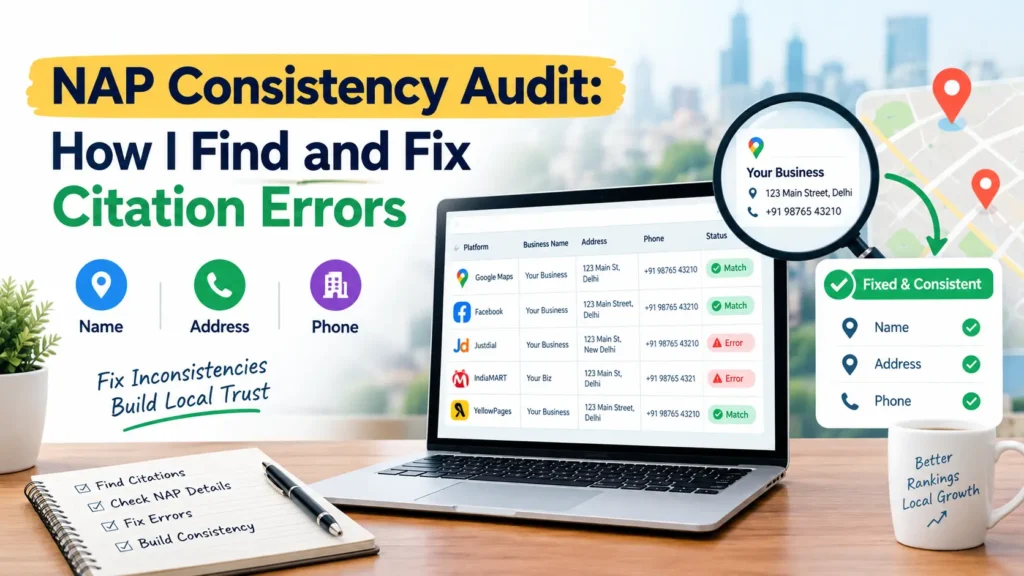
NAP consistency audit showing business citation errors and corrections for local SEO
A NAP consistency audit compares your business name, address and phone number across Google Business Profile, your website and directories, then corrects every mismatch. Citation consistency now carries less ranking weight than it once did, but it still protects customer trust and may influence how AI search tools describe your business.
What Is NAP Consistency in Local SEO?
NAP consistency means your business name, address and phone number (NAP) appear identically everywhere they are published online: your website, Google Business Profile (GBP), social profiles, directories and any other listing. Each of those mentions is a local citation. A citation that is missing one of the three details is called a partial NAP.
The idea is simple. When ten sources agree on who you are and where you are, search engines and customers can trust the data. When sources conflict, both have to guess. If you would rather have this done for you, see my local citation & NAP audit services.
Table of Contents
ToggleDoes NAP Consistency Still Affect Local Rankings in 2026?
Yes, but far less than most older guides claim. In Whitespark’s 2026 Local Search Ranking Factors report (47 local SEO experts, published November 2025), citation signals lost roughly another half a percentage point of weight in the local pack and Maps results, continuing a downward trend.
The same report shows where consistency still counts. Your website’s NAP matching your GBP NAP ranked 15th among local pack factors. Citation consistency on the main map platforms (Google Maps, Bing Maps, Apple Maps) ranked 28th, on key directories 63rd, on data aggregators 85th and on other citation sources 123rd.
My reading: fix your own website and the platforms people actually see first, and treat long-tail directories as clean-up work. Consistency is also a trust issue. A 2023 BrightLocal survey of 1,138 US consumers found that 62% would avoid a business with incorrect information online, and 28% of those who found a wrong address would look for an alternative. That is older, US-only data, so use it as direction rather than a benchmark for India. For the wider picture of what moves rankings, read my Google Business Profile optimization playbook and these local SEO tips for ranking on Google Maps.
What Counts as a Citation Error?
A citation error is any listing where your name, address or phone number differs from your canonical NAP, or where a duplicate listing exists for the same location. These are the types I log, with the priority I give each.
| Error type | What it looks like | Priority | Fix |
|---|---|---|---|
| Wrong or old phone number | Previous number still shown on a directory | High | Claim or edit the listing and update the number |
| Old address after a move | Former address on Facebook, Apple Maps or an industry directory | High | Update at source; request an edit where you cannot log in |
| Duplicate listing | Two profiles for the same location | High | Merge or remove, keeping the verified one |
| Business name variation | Legal suffix, abbreviation or an added keyword | Medium | Match the real-world name used on signage and your website |
| Partial NAP | Phone shown, address missing | Low | Complete the listing when you next edit it |
| Formatting difference | "St" vs "Street", "+91" vs "0" prefix | Low | Standardise on every new submission |
| Third-party error | Wrong details in a news article or event page | Low | Contact the editor only if the site is authoritative |
Why Do NAP Inconsistencies Happen?
Most NAP errors come from change, not carelessness: a rebrand, a shop move, a new phone line, a tracking number added to one listing, or a directory that copied old data from another source. Agencies and former staff who created listings under their own logins add to the mess, because nobody remembers where the profiles live.
How Do You Run a NAP Consistency Audit? My 6-Step Process
A NAP consistency audit has six steps: define the canonical NAP, check your own website, find citations across the web, log every mismatch, fix by priority, then recheck. I run it in this order because each step depends on the one before.
Step 1: What Is Your Canonical NAP?
Your canonical NAP is the single version of name, address and phone number that every source must match. Build it from Google’s own rules. Per Google’s Business Profile guidelines, the name should match your real-world name (no taglines, keywords or hours), the address must be a real physical location (no P.O. boxes or virtual offices), and the phone number should be a local line you control rather than a call-centre or redirecting number.
Write the canonical NAP in one cell, in the exact format you will use everywhere, and share it with anyone who edits listings.
Step 2: Is Your Own Website Consistent?
Audit your site before any directory, because it is the source others copy and the NAP factor Whitespark ranked highest. Check the header, footer, contact page, location pages, schema and any landing pages used for ads. I crawl the site and extract phone and address strings from every page, using the same method as in my 5-step technical SEO audit framework. Then I confirm the structured data matches, following my schema markup implementation guide.
Step 3: How Do You Find Citations and Errors Across the Web?
Search for your business the way a stranger would. Put your phone number, old numbers, old addresses and name variations in quotation marks in Google, in each format you have ever used. Note every listing that appears, including ones you did not create.
Citation trackers such as BrightLocal or Whitespark speed this up for larger audits. Whitespark’s Darren Shaw has advised concentrating cleanup on sites where real people see listings: Google, Bing, Apple Maps, Facebook, Yelp and major industry directories (a 2024 recommendation). For Indian businesses I add the directories customers use in that category, such as Justdial, Sulekha or IndiaMART where relevant.
Step 4: How Do You Log Mismatches?
Log every listing in one spreadsheet with these columns: listing URL, source type, name shown, address shown, phone shown, error type, priority, login owner, date fixed and date rechecked. The “login owner” column matters most, because the commonest blocker is not knowing who holds the account.
Step 5: How Do You Fix Incorrect Citations and Duplicate Listings?
Fix in this order: Google Business Profile, Apple Maps, Bing, Facebook, major directories, then everything else. For claimed listings, edit directly. For unclaimed ones, claim them or submit an edit request. For duplicates, use the platform’s merge or removal process and, in my practice, keep the verified profile.
Two cautions. Never add keywords to your business name to “fix” it; Google says unnecessary information in the name can lead to suspension. And keep your primary phone number consistent; Google’s guidelines allow additional numbers on local surfaces, so treat any call-tracking number as secondary. See a full client example of local SEO work in my Boss Auto Rentals local SEO case study.
Step 6: When Should You Recheck?
Recheck about a month after your edits, because directories update at different speeds, then diary a repeat audit. Do not re-audit daily; propagation takes time and constant changes can create new mismatches.
What Is the Best NAP Format for Citations and Schema?
The best NAP format is the one you pick once and repeat exactly. BrightLocal notes that Google generally understands small differences such as “Street” versus “St”, so formatting is a low-priority issue. Even so, a single format makes audits faster and mismatches obvious.
Use the same name spelling, the same address line order and the same phone format everywhere, including the international +91 format if you target visitors from outside India. In JSON-LD, use the same values as your visible text. Whitespark ranked NAP in schema on the GBP landing page 118th, so it supports your visible NAP rather than replacing it.
How Do Service-Area and Multi-Location Businesses Handle NAP?
A service-area business with no storefront keeps one profile for its base, with a defined service area, and hides the address from customers. Google’s guidelines say the service area should generally not extend beyond about two hours’ driving time from the base. Businesses with several staffed locations can have one profile per location, each with its own local phone number. Where you have no public address, make sure the hidden address on GBP still matches what you use for private records, so verification and listings stay aligned.
Does NAP Consistency Matter for AI Overviews, ChatGPT and AI Search?
It appears to matter more for AI visibility than for classic rankings, though the evidence is expert opinion, not official documentation. Whitespark’s 2026 report states that three of the top five AI search visibility factors are citation factors, and that in AI search, mentions are the new link.
No AI platform has published how it selects local businesses, so I do not promise results. The practical step is cheap: keep one name and one NAP across every mention so generative systems have consistent entity data to draw from. I explain the wider approach in my Generative Engine Optimization (GEO) guide and my Answer Engine Optimization (AEO) guide.
How Does NAP Fit Into Ads, Site Speed and Your SEO Learning Path?
NAP discipline reaches beyond organic listings. If you run call or location assets in Google Ads, the number and address should match your landing page, which I cover in my Google Ads account structure framework. Landing page experience is one component of how to improve your Google Ads Quality Score, so a page that shows clear, matching contact details helps visitors act.
Citation links often send mobile visitors to your location page, so speed matters; my Core Web Vitals before-and-after case study shows the fixes I use. If you want to learn this yourself, start with the SEO roadmap for 2026 and see what students learn in my SEO training program.
How Often Should You Audit NAP Consistency?
Audit NAP consistency at least once a year, and immediately after any change of name, address, phone number or website. Multi-location businesses benefit from a quarterly check because one branch update can create several mismatches. This schedule is my own working practice, not a Google requirement.
Need Your Citations Audited and Cleaned Up?
If you want a clear list of every mismatched listing and a prioritised fix plan, explore my local SEO services in Delhi NCR or call me now to talk it through.

Abhay Saxena is an experienced SEO strategist, digital marketing consultant, and founder of SEO Pathshala, based in Delhi, India. With over 7 years of hands-on experience in Search Engine Optimization, he has helped businesses enhance their online visibility, improve organic rankings, and achieve measurable growth through structured and data-driven SEO frameworks.
His core expertise includes Technical SEO, Local SEO, Core Web Vitals optimization, Google Search Console strategy, GA4 analytics insights, and AI-powered search optimization including AEO (Answer Engine Optimization) and WebMCP integration.
Abhay is passionate about simplifying complex SEO concepts and regularly shares practical tutorials, industry insights, and real-world strategies through SEO Pathshala. His mission is to empower marketers, entrepreneurs, and business owners with sustainable SEO strategies that align with the evolving AI-first search ecosystem.